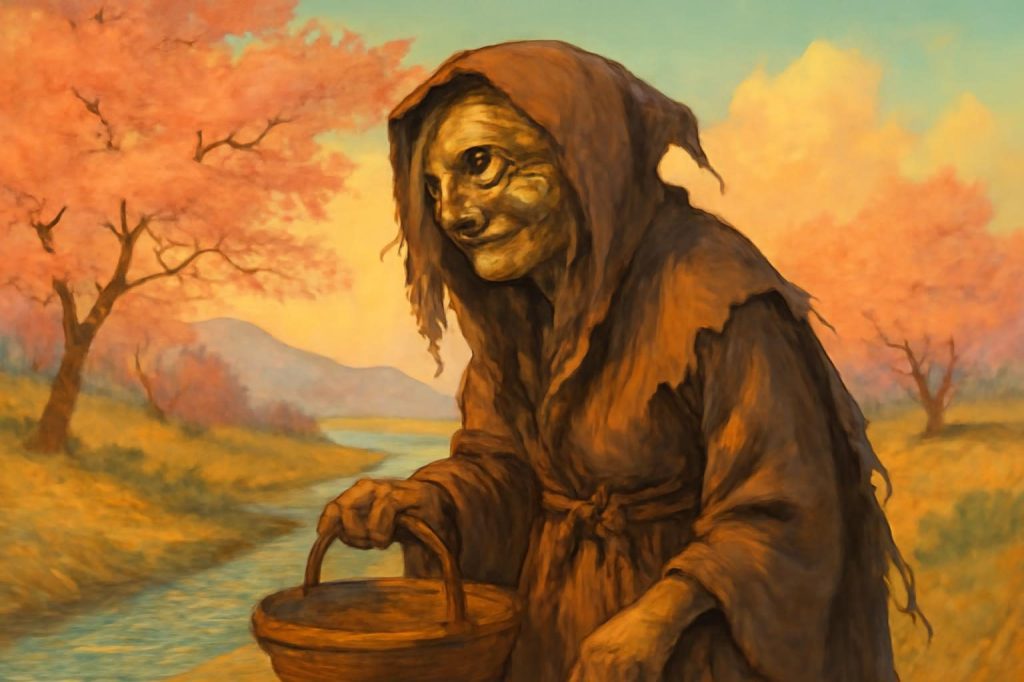
In Kohoku Ward, Yokohama, Kanagawa Prefecture, local lore tells of Mikaribaba (ミカリ婆さん), a one-eyed old woman said to come around on the night of Kotoyoka, the “Eighth-Day” observance in the old calendar. Her story is a small but well-recorded piece of Kanto folk belief, and it shows how household customs and yokai legends grew together.
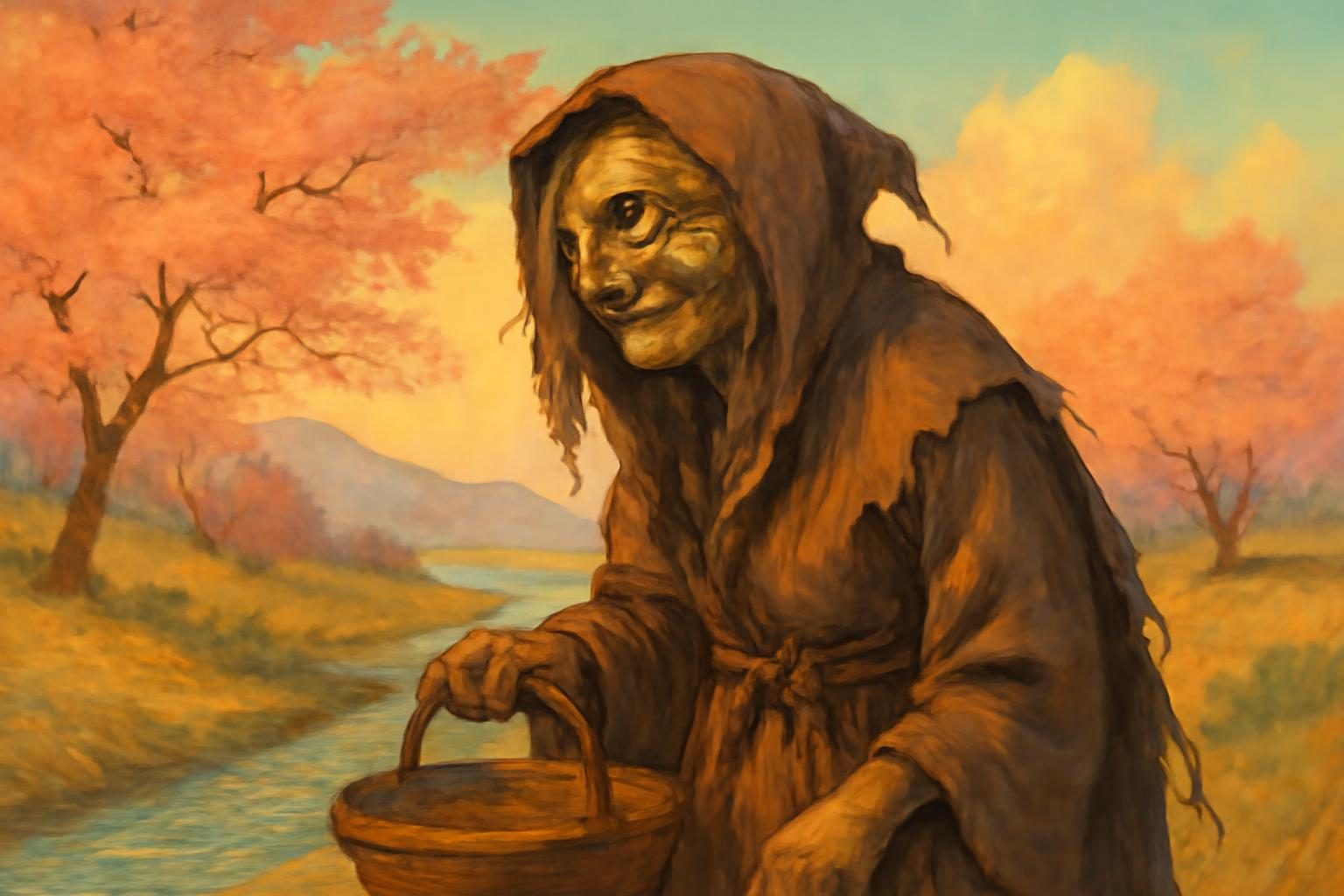
Who Is Mikaribaba? The One-Eyed Hag of Yokohama
LEGEND: The story of Mikaribaba
According to the legend (言い伝え), Mikaribaba is a one-eyed old woman who visits homes on the eighth day of the 12th month and the eighth day of the 2nd month of the lunisolar calendar. Wikipedia, drawing on Murakami Kenji’s Yokai Jiten (2000), records that she was said to visit together with a hitotsume-kozo (one-eyed boy) and to “borrow” sieves and even people’s eyes.
FACT: Competing explanations of the name
The name itself is explained in different ways. Some references, including the English Wikipedia article, write it as 箕借り婆 (“winnowing-basket-borrowing hag”). The Okura Institute for the Study of Spiritual Culture in Kohoku Ward, however, states plainly that calling her the “mino-borrowing old woman” is a misunderstanding. In its account, the name comes from mikawari, a word corresponding to chisai, a strict form of ritual abstinence in Shinto. The same source notes that Mikaribaba and the hitotsume-kozo were originally separate beings, and that the tradition of her being one-eyed arose as the two gradually became confused.
When Mikaribaba Visits: Kotoyoka Nights
FACT: What Kotoyoka was
According to the Okura Institute, December 8 was once called “Yokazo” or “Kotoyoka” (事八日) in the Kohoku area, and on this day a hitotsume-kozo or Mekari-basan was said to come. The “koto” originally meant a festival or ritual. The same source also mentions a tradition that Mikaribaba comes on December 1, calling her a god of shimatsu (tidying up and frugality).

Warding Customs: Baskets, Sieves, and Dumplings
LEGEND: Why baskets go on the roof
The local explanation recorded by the Okura Institute is simple: Mikaribaba has one eye and fears things with many eyes. So in Ura-no-Yato, Toriyama-cho, people raised baskets (zaru) or sieves onto the ridge of the roof or set them out by the door. A loosely woven bamboo basket was said to make the monster think, “So this house has someone with this many eyes,” and flee in surprise. In Futoo’s Boda-yato, the related Yokado was said to glare down from the rooftops with a thousand eyes, so people put out a basket or mesh colander.
Wikipedia, citing the Yokai Jiten, adds another Toriyama tradition: a greedy Mikaribaba came to pick up spilled rice grains and could cause fires with the fire in her mouth, so households placed “tsujoo dango” made from leftover rice at the doorway to show there was no rice left to collect.
The Folklore of Toriyama: Tracing the Legend in Kohoku-ku
LEGEND: Local tales of Mikaribaba
The Okura Institute records a Toriyama legend: Mikaribaba made her rounds of the villages and flew all the way to Hakone, where she struck the mountain and fell into the sea, and so she does not go west of Hakone. Yokado (ヨウカドウ) is said to be the same being. In nearby Hiyoshi, people instead feared a hitotsume-kozo passing through the sky and put a kagotoshi basket on the roof, sending children to bed early that night.

From Ritual to Yokai: The Seclusion Theory
FACT: The scholarly perspective
The Okura Institute explains that on Kotoyoka people once observed monoimi (ritual abstinence, staying indoors) because the god of the “koto” was thought to visit. Over time the original meaning was forgotten, and because people stayed shut in their houses, they came to believe that monsters such as the hitotsume-kozo and Mikaribaba were coming. Wikipedia, citing Sakurai Tokutaro’s Minkan Shinko Jiten, describes similar periods of home seclusion called “mikawari” or “mikari” in southern Chiba.
Exploring Japanese Folklore and Yokai Heritage in Kanagawa
FACT: Yokai culture in Kanagawa
Kanagawa Prefecture has many recorded yokai traditions, and Mikaribaba is one of them. The Okura Institute’s article also mentions other Kohoku lore, such as the one-eyed carp said to live in the “I-no-ike” pond of Morooka Kumano Shrine.

Related on JAPAN ESSENCE: Unraveling the Nyudo-Bozu: The Shifting Monk Yokai of Shinshiro | Exploring Oboke’s Yokai Village: Shikoku’s Hidden Valley of Japanese Folklore
Sources
- Okura Institute for the Study of Spiritual Culture, “Waga Machi Kohoku” No. 12
- Mikaribaba – Wikipedia
- The Yokai Encyclopedia of Kanagawa Prefecture | YOKAI.JP
- みかり婆 | Yokai Encyclopedia
To explore further, visit Oni Kobo (鬼工房) for onigawara demon-tile art and charms and Onigawara Experience for hands-on onigawara experiences in Japan.


Leave a Reply