It is the last night of the year on the Oga Peninsula, a thumb of land pushing out into the Sea of Japan from Akita, in Japan’s snowy north. Inside, the family has the food laid out and the sake ready. Outside, something is coming up the path through the snow.
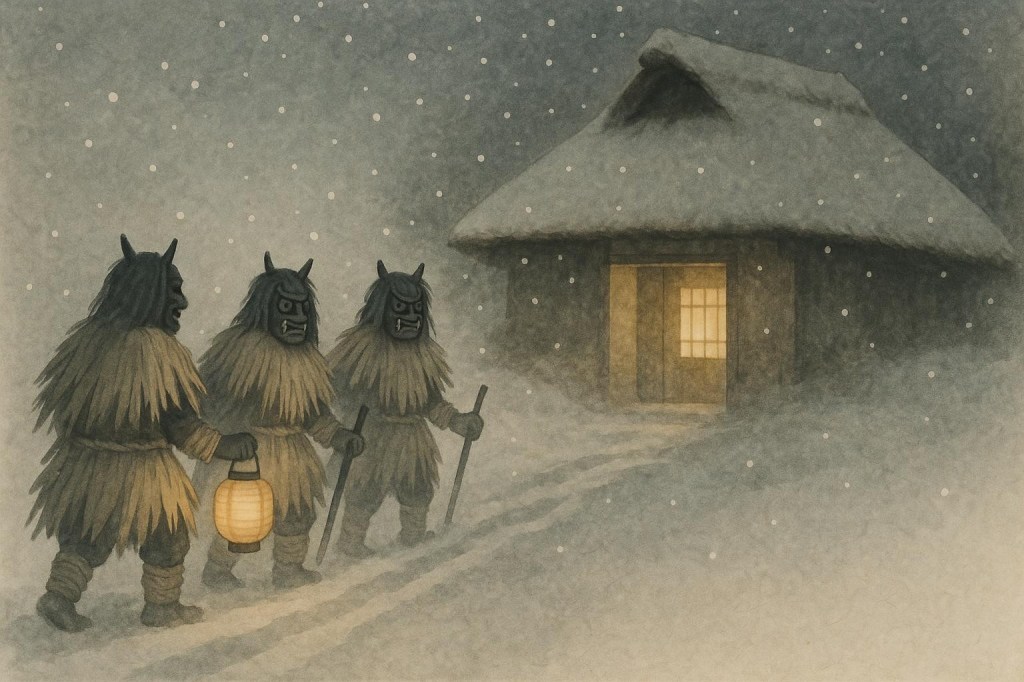
You hear it before you see it. Heavy straw boots stamping. Then a roar at the door:
“Naku ko wa inee gaa! Oya no iu koto kigane ko wa inee gaa!”
Any crying kids here? Any kids who don’t listen to their parents?
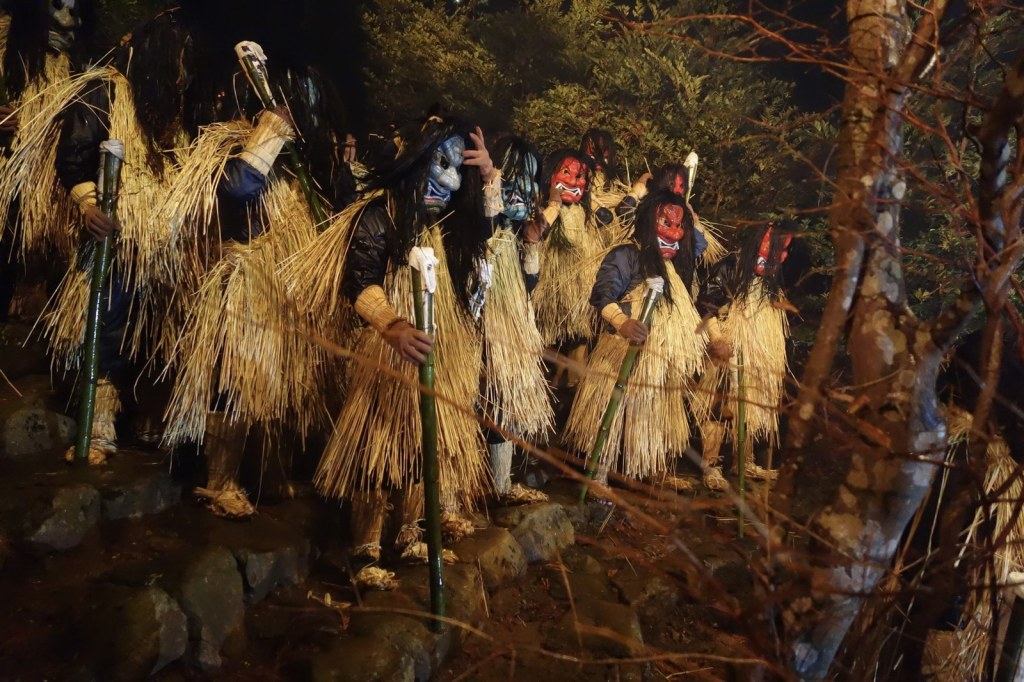
The door slides open and in they come: huge, wild-eyed faces with bared teeth, bodies wrapped in shaggy capes of straw, a big knife in one hand. Small children scream and hide behind their fathers. The grown-ups know exactly who has come to visit.
These are the Namahage. In English they are usually called demons or ogres. The people of Oga would tell you something else. They are gods.
Not demons, but visiting gods
According to Oga City, the Namahage are raiho-shin, “visiting deities” who arrive at the turning of the year. They come to scold laziness, and they bring good health, good harvests from the fields, and the riches of the mountains and the sea.
So the household does not lock the door. It welcomes them. Families receive the Namahage with food and sake, prepared according to etiquette handed down for generations. The shouting, the stamping and the tears are all part of a blessing.
The figures behind the masks are the young men of each community, who dress up and go from house to house. The custom used to be held at Koshogatsu, the “Little New Year” in mid-January, and today takes place on December 31. On New Year’s Eve 2025, it was held in 71 communities across Oga.
In 1978 the custom was designated an Important Intangible Folk Cultural Property of Japan. On November 29, 2018, UNESCO inscribed it on its list of Intangible Cultural Heritage as one of ten similar events from eight prefectures, grouped together as Raiho-shin: ritual visits of deities in masks and costumes.
What the name means
The name hides a small, very human joke about winter.
If you sit too long by the irori, the sunken hearth of an old farmhouse, red heat blotches form on your hands and legs. In the Oga dialect these are called namomi. Peeling them off, namomi-hagi, became “Namahage.” The visiting gods come to strip the marks of laziness from people who have spent the winter hugging the fire.
Oga City adds that peeling off the namomi was also a blessing for the new year, aimed especially at the newest members of the household: children, and young brides who had just married into the family. That is why some Namahage also shout at the door to ask whether the new bride is getting up early.
How a Namahage dresses
Everything a Namahage wears tells you where it came from. According to Oga City:
- The mask. Masks differ from district to district. They have been made from tree bark, carved wood, paper pasted over a basket, and papier-mâché. Today many are plastic, and many are carved by local woodcarvers.
- The kede. A straw cape worn like a raincoat. Together with the mask, it is the costume that turns a young man into a god.
- The habaki. Woven straw shin guards. Wearing them means you have come from somewhere else.
- The straw boots. For walking a long way through the snow.
- The knife or the staff. A big kitchen knife, for peeling off the namomi. In some districts they carry a staff topped with gohei, the zigzag paper streamers that mark something sacred.
The mountain gods, in other words, have walked a long way through the snow to get to your door.
Legend says: the oni and the 999 steps
Oga has its own story about where the Namahage came from. It is a legend, told at Akagami Shrine and in the local museum, and it goes like this.
Long ago, Emperor Wu of the Han dynasty in China came to Oga looking for the herb of eternal life. He brought five bats with him, and the bats turned into five oni who worked for him. Once a year, on the fifteenth day of the first month, the emperor gave them a day off. The oni went down to the villages and ran wild, stealing crops and livestock and even carrying off the village girls.
The desperate villagers made a bet. If the oni could build a stairway of a thousand stone steps, from the shore up to the Goshado halls of Akagami Shrine, in one night before the first rooster crowed, the village would give them a girl every year. If they failed, they must never come down to the village again.
The villagers thought it was impossible. But the oni piled the stones higher and higher. When they had laid 999 steps, with just one to go, a cry rang out in the dark: kokekokko! A rooster crowing.
It was not a rooster. In one version a clever villager made the sound. In another it was an amanojaku, a contrary little spirit who always does the opposite of what is wanted. The oni were shocked and furious. They tore up a thousand-year-old cedar, drove it upside down into the ground, and went back into the mountains, never to return.
How does that become a New Year’s custom? Here the stories split. One local version says the villagers, oddly, began to miss the oni, and started dressing up like them and walking through the village on the fifteenth of the first month. Another, told by the Namahage Museum, says the villagers worried the oni might come back for revenge, and to keep them calm they began inviting local young people dressed as oni to a feast each year. Both are folk explanations, and both end at the same door.
What history and scholars say
Outside the legend, Oga City lists three main theories. One says the Namahage grew out of the yamabushi, mountain ascetics training on Oga’s sacred peaks, Mt. Shinzan and Mt. Honzan, who sometimes came down to the villages in their fearsome robes to pray at each house. Another says the peninsula looks like a mountain floating in the sea when seen from offshore, and the Namahage are messengers of the mountain god who watches over the villagers’ lives. A third says they began as foreign sailors shipwrecked on the Oga coast, whose looks and language seemed like those of oni to the people who found them.
The oldest written record comes from the Edo-period traveler Sugae Masumi (1754–1829). He visited the Namahage of Miyazawa, in Oga, on the fifteenth day of the first month in 1811, and left both a detailed description and a drawing. Later, the custom drew some of Japan’s best-known thinkers: the folklorists Yanagita Kunio and Orikuchi Shinobu, and the artist Okamoto Taro.
How to meet the Namahage
The real New Year’s Eve visits are a private ritual inside people’s homes, so travelers cannot simply join in. Please don’t go knocking on doors in Oga on December 31. The good news is that Oga has honest, welcoming ways to meet them on any day of the year.
- Namahage Museum (Namahage-kan). More than 150 masks that were actually used in Oga’s communities stand together in one room, and the effect is overwhelming. There is also a film about the New Year’s Eve ritual, and a corner where you can try on a real Namahage costume. Open every day, 8:30 to 17:00. Admission is ¥660 for adults and ¥330 for school students, according to Oga City (checked October 6, 2026).
- Oga Shinzan Folklore Museum (Oga Shinzan Denshokan). Next door, in a traditional L-shaped farmhouse, a session of about 20 minutes explains the New Year’s Eve visit of the Kitaura-Shinzan district and then faithfully re-creates it. This is the closest you can get to the real night. Sessions run daily, 13 times a day from April to December and 6 times a day from January to March. A combined ticket with the Namahage Museum is ¥1,100 for adults and ¥660 for school students.
- Shinzan Shrine. About five minutes’ walk from the museum. Here, on the second Friday, Saturday and Sunday of February, the Namahage Sedo Festival combines a Shinto fire ritual with the Namahage. Bonfires burn in the shrine grounds, and the Namahage come down from the mountain.
- The 999 steps to Akagami Shrine Goshado. If you want to walk the oni’s stairway, the climb from the Monzen parking area takes about 25 minutes, according to Oga’s tourism site. The steps are rough and uneven, which seems fair for a stairway said to have been built by oni in a single night, so leave the heels and sandals behind. Walking sticks are provided near the parking area. By local bus, take the Oga Minami line from JR Oga Station to the Monzen parking stop. The local tourism site also says the five oni are enshrined at the Goshado as a family of parents and three children, and that the upside-down cedar is said to be kept at the shrine office.
Opening hours, sessions and bus times change, so check the official sites before you go.
A frightening face at the door
It is easy to look at a Namahage mask and see only a monster. But think about what actually happens on that night. A fearsome figure walks out of the snowy mountains, roars at the door, makes the children promise to behave, eats and drinks with the family, and leaves the house blessed for another year.
Japan has a long habit of putting its most frightening faces to work as protectors. Look up at the roof of an old temple in Kyoto and you will often find another one: the onigawara, a demon-faced tile at the end of the ridge, glaring out at the world so that misfortune stays away from the people underneath. The Namahage do the same job, only they come down off the mountain and knock.
When the shouting stops and the straw boots crunch away down the path, the house is quiet again. Somewhere a child is still sniffling. And the year can begin.
Sources & Further Reading
- Namahage Museum — Oga no Namahage
- Oga City — Important Intangible Cultural Asset: Oga’s Namahage
- Oga City — Oga Shinzan Folklore Museum
- UNESCO Intangible Cultural Heritage — Raiho-shin, ritual visits of deities in masks and costumes
- Agency for Cultural Affairs, Cultural Heritage Online — Oga no Namahage (男鹿のナマハゲ) (in Japanese)
- Oganavi (Oga tourism guide) — Akagami Shrine Goshado
Shape your own oni face in Kyoto
If the Namahage have you looking at fierce faces in a new way, you can meet the roof-top kind in Kyoto. In Higashiyama, near Gojo Ohashi bridge, Kawarakoubou YOU-ya is a kawara (roof tile) workshop and gallery where you can shape your own demon-faced onigawara tile from clay.
- Visit the workshop and gallery
- Book the onigawara-making experience (adults ¥14,000, tax included)