Stand in front of almost any old castle keep in Japan and your eyes go where the builders wanted them to go: up the white walls, past the curving eaves, all the way to the ridge. And there, at both ends of the highest beam, something is doing a handstand.
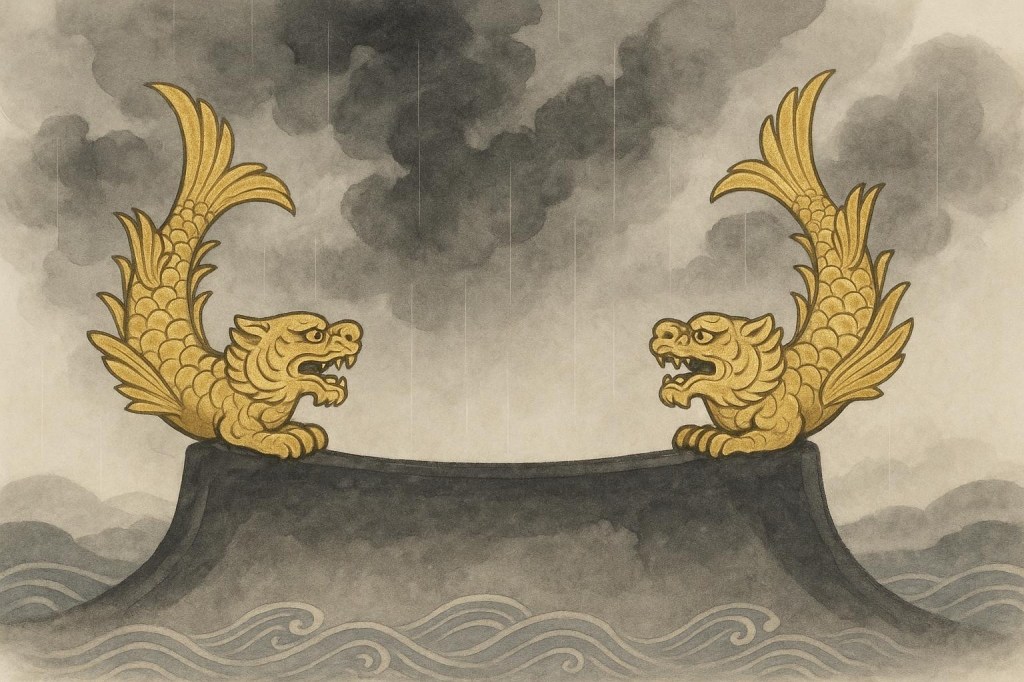
It has the head of a tiger, or maybe a dragon. Its body is a fish, covered in scales. Its tail is flung straight at the sky, as if it dove off the roof and froze halfway down. Some are gilded. Most are the soft grey of fired clay.
This is a shachihoko, often just called shachi. If you watched any of the Asian Games in Aichi and Nagoya, which closed on October 4, 2026, you have already met a friendly version of it: the official mascot, Honohon, was designed after the shachihoko. The real thing is older, stranger, and much more serious about its job.
A fish that swallows the sea
In Japanese folklore, the shachihoko is a sea creature from the cold northern ocean. Its fins and tail always point toward heaven, and its back bristles with sharp spines. Most importantly, it can swallow huge amounts of water, hold it in its belly, call up clouds, and bring rain.
That last power explains why it lives on a roof instead of in the sea.
Old Japanese buildings were made of wood. Temples, gates, palaces and castle keeps could survive centuries of earthquakes and typhoons and then vanish in a single night of fire. So builders placed a creature of water at the very top of the building. According to the legend, if fire ever broke out, the shachihoko would release the water it carried and put the flames out.
It is a charm, not a sprinkler system. But stand under one and you can feel the logic: this is the highest point, the place a spark from a neighboring fire would land, and here sits a beast that belongs to the ocean.
Where the shachihoko came from
The idea did not start in Japan. Long before shachihoko, Chinese roofs carried ridge-end ornaments meant to protect buildings from fire, and that tradition made its way to Japan. The Japanese shachihoko grew out of it.
It took a while to settle on a name. Old Japanese writings call these ornaments by Chinese-style names, and the word shachihoko only became the usual name from the middle of the Edo period. The creature itself appears earlier: a picture scroll from around 1295 already shows one sitting on a roof.
For a long time, shachihoko decorated temples and shrines. Then the warlords took notice. Oda Nobunaga is said to have used them on the keep of his Azuchi Castle, and from there they spread to castle roofs across the country. Under Nobunaga and his successor Toyotomi Hideyoshi, some shachihoko had gold leaf on their faces and fins. The fire charm had become a sign of power, and whoever lived under the gold was telling everyone how much they owned.
Why they come in pairs
Look closely and you will usually find two shachihoko on one ridge, one at each end. Very often they are a male and a female. The male has its mouth open and the female has its mouth closed, like the pairs of guardian lion-dogs (komainu) at a shrine entrance. One mouth makes the first sound, “a,” and the other the last sound, “un.” Together they cover everything from beginning to end.
There are exceptions. At Himeji Castle, only a single old model survived to copy, so the keep’s shachihoko were all rebuilt in the same form, and whether that model was male or female is still uncertain.
Clay, gold and copper
Most shachihoko on castle keeps and gates are fired clay, made as special roof tiles. Clay shachihoko are hollow, which makes them fragile. They are fixed onto a vertical rod rising out of the ridge. Others are carved from wood and covered in copper sheet, and a few are cast in bronze.
Then there are the famous golden ones.
The golden shachi of Nagoya Castle
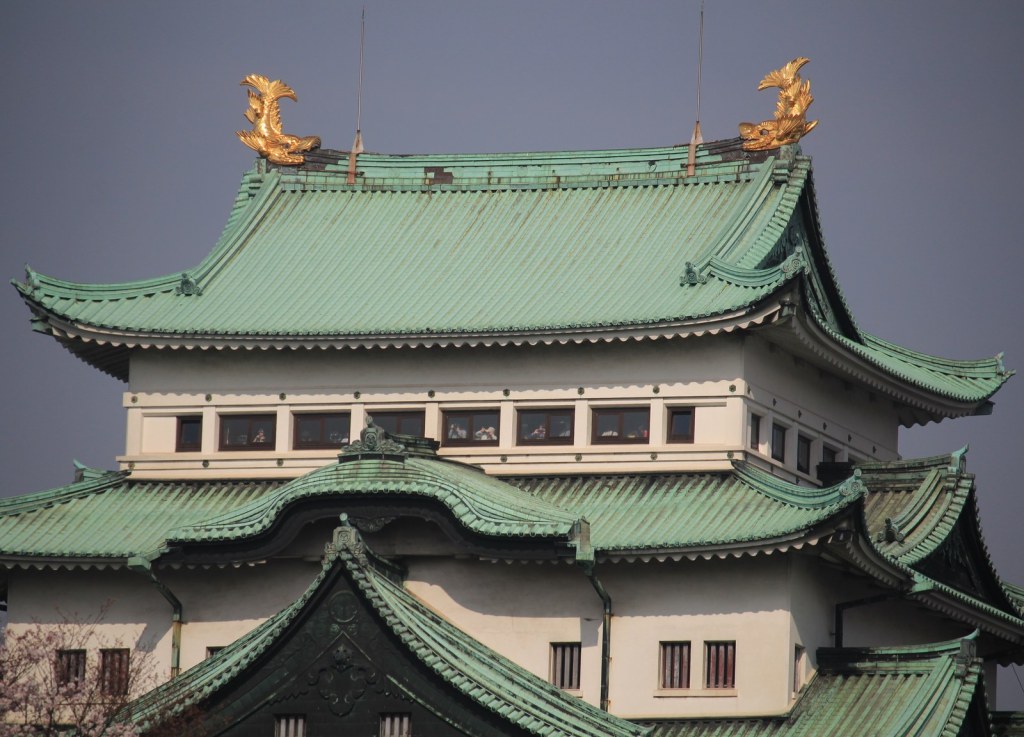
When Nagoya Castle’s enormous keep was finished in 1612, a pair of golden shachihoko went on top. They showed off the power of Tokugawa Ieyasu and the Owari branch of the Tokugawa family. An old song from the Edo period claimed they shone so brightly that fish would not come near the shore at nearby Atsuta. Travelers on the Tokaido road sang about them too.
Gold is tempting, though. Whenever the Owari domain ran short of money, it looked at its shachi, and before the Meiji era the gold was recast three times.
The originals guarded the castle for 333 years. In May 1945, an air raid burned the keep, and the golden shachi with it. The people of Nagoya rebuilt them from detailed survey drawings, and the second-generation pair now sits on top of the reconstructed keep.
By the official castle figures, the pair is clad in 18-karat gold plates just 0.15 mm thick:
- North (male): 2.621 m tall, 1,272 kg, 112 scales, 44.69 kg of 18k gold
- South (female): 2.579 m tall, 1,215 kg, 126 scales, 43.39 kg of 18k gold
The male is bigger, but the female has more scales.
The secret in the scales
Some scales from the original shachi survived the 1945 fire, and they are still carefully kept today. For years, though, they posed a small mystery. Some look almost pure gold to the eye, yet earlier X-ray analysis did not find especially high gold levels in them.
In August 2026, a team from Japan’s High Energy Accelerator Research Organization (KEK), the Nagoya Castle Research Center, the National Museum of Nature and Science and others published an answer. Using a beam of negative muons at the J-PARC research facility, they analyzed seven surviving scales without damaging them, measuring the metal at different depths below the surface.
In five of the seven, gold became more concentrated toward the surface, within about 10 micrometers of it, reaching roughly 65 to 90 percent gold depending on the scale. A patch that seems to be a later repair showed almost no change with depth, unlike the original metal. The researchers say this points to a deliberate historical surface treatment that concentrated gold at the very skin of each scale, which would explain the deep golden shine.
In other words, the brilliance that kept the fish away from Atsuta beach may have been engineered, one scale at a time.
How to see shachihoko on your trip
- Nagoya Castle is the classic place to see them, and an easy day trip if you are based in Kyoto. The reconstructed keep is currently closed to visitors, according to the castle’s official website (checked October 2026), but the golden shachi can be seen from the castle grounds. Bring a zoom lens or binoculars.
- Look at every castle you visit. Keeps, turrets and gatehouses often carry clay shachihoko. Compare the tails: some fan out like a fan, others split in two.
- Check the mouths. Find the pair and see which one is open.
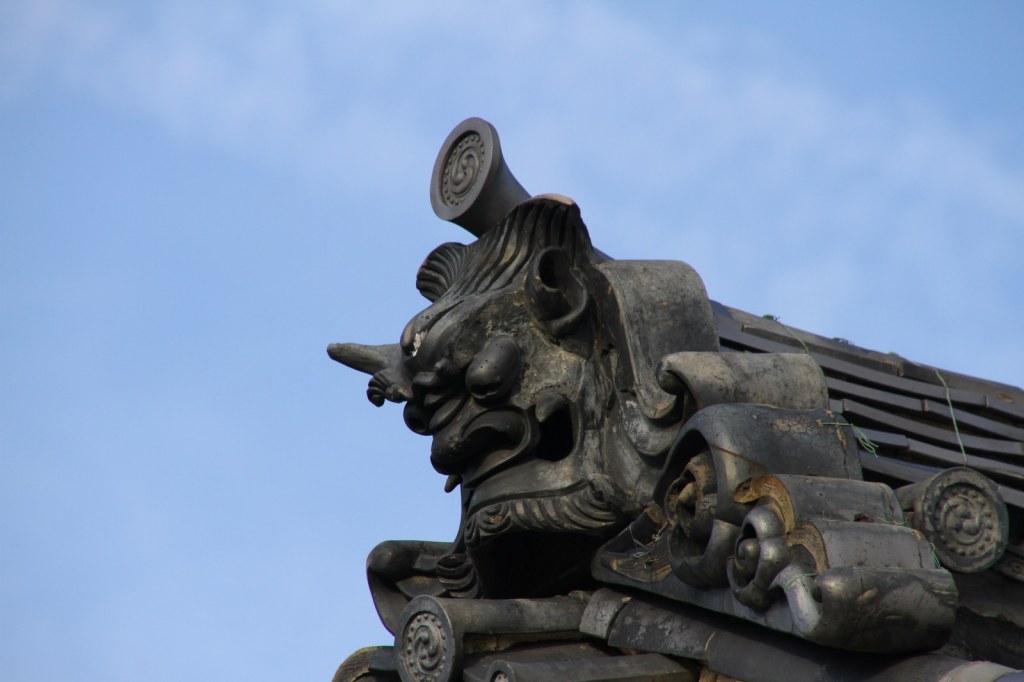
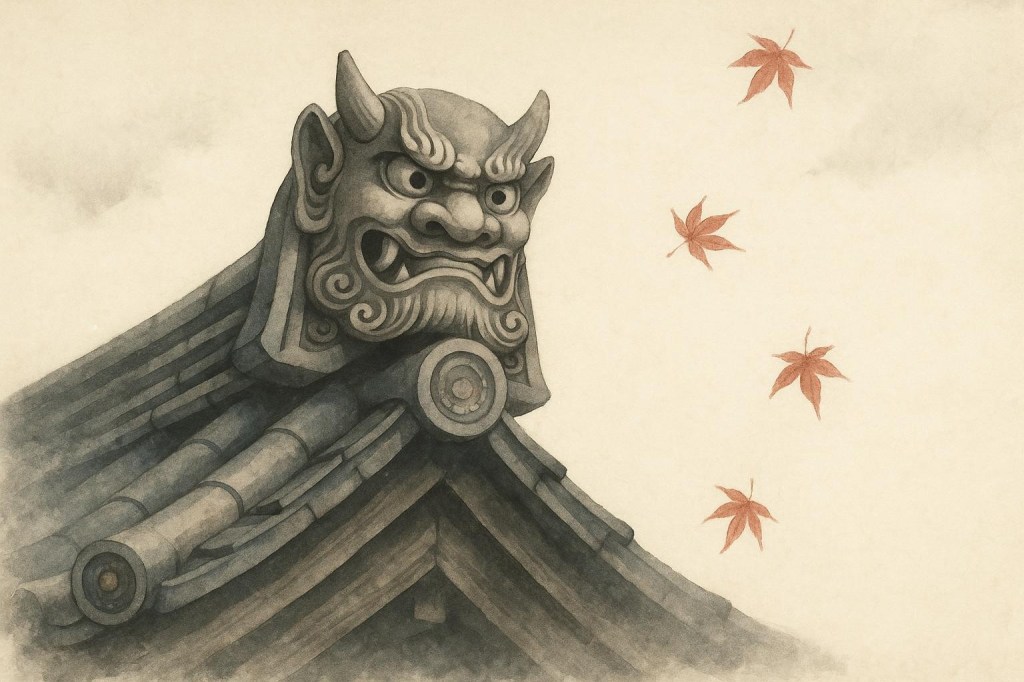
- Look at temple roofs too. Ridge ends are where Japanese builders put their protectors: shachihoko on some roofs, demon-faced onigawara tiles on others. Once you start looking up, Japanese skylines stop being background.
A beast that stands on its head
In Japanese, the word shachihoko-baru, to stand stiffly like a shachihoko, describes someone who is tense and overly formal. It is a funny image for a creature that spends its whole life upside down on a rooftop.
But maybe that stiffness is the point. For centuries these fish have held the same pose through storms, sieges, recastings and fire, keeping the ocean in their bellies and waiting for the night they are needed. Next time you walk under a Japanese roof, look up and say hello. One of them may be looking back with its mouth open, and the other with its mouth firmly shut.
Sources & Further Reading
- Nagoya Castle Official Website — Kinshachi (Golden Shachihoko) (in Japanese)
- Nagoya Castle Official Website — About the Special Historic Site, Nagoya Castle
- J-PARC Center / KEK — Press release, Aug. 24, 2026: Near-surface gold enrichment in Nagoya Castle’s kinshachi scales confirmed with negative muons (in Japanese)
- Japan Tourism Agency (Matsumoto Castle interpretive text) — Shachi Tiles
- JAANUS (Japanese Architecture and Art Net Users System) — shachi 鯱
- Aichi-Nagoya 2026 Asian Games Organizing Committee — Official Mascot HONOHON
- Kobe Shimbun (Sept. 15, 2014) — Himeji Castle: are all the shachihoko female? (大天守の“殿”不在の謎 しゃちほこは全て雌? 姫路城) (in Japanese)
See Japanese roof-tile craft up close in Kyoto
If this story has you looking up at rooftops, you can see the tile-maker’s craft at eye level in Kyoto’s Higashiyama, near Gojo Ohashi bridge. Kawarakoubou YOU-ya is a kawara (roof tile) workshop and gallery where you can also shape your own demon-faced onigawara tile from clay.
- Visit the workshop and gallery
- Book the onigawara-making experience (adults ¥14,000, tax included)