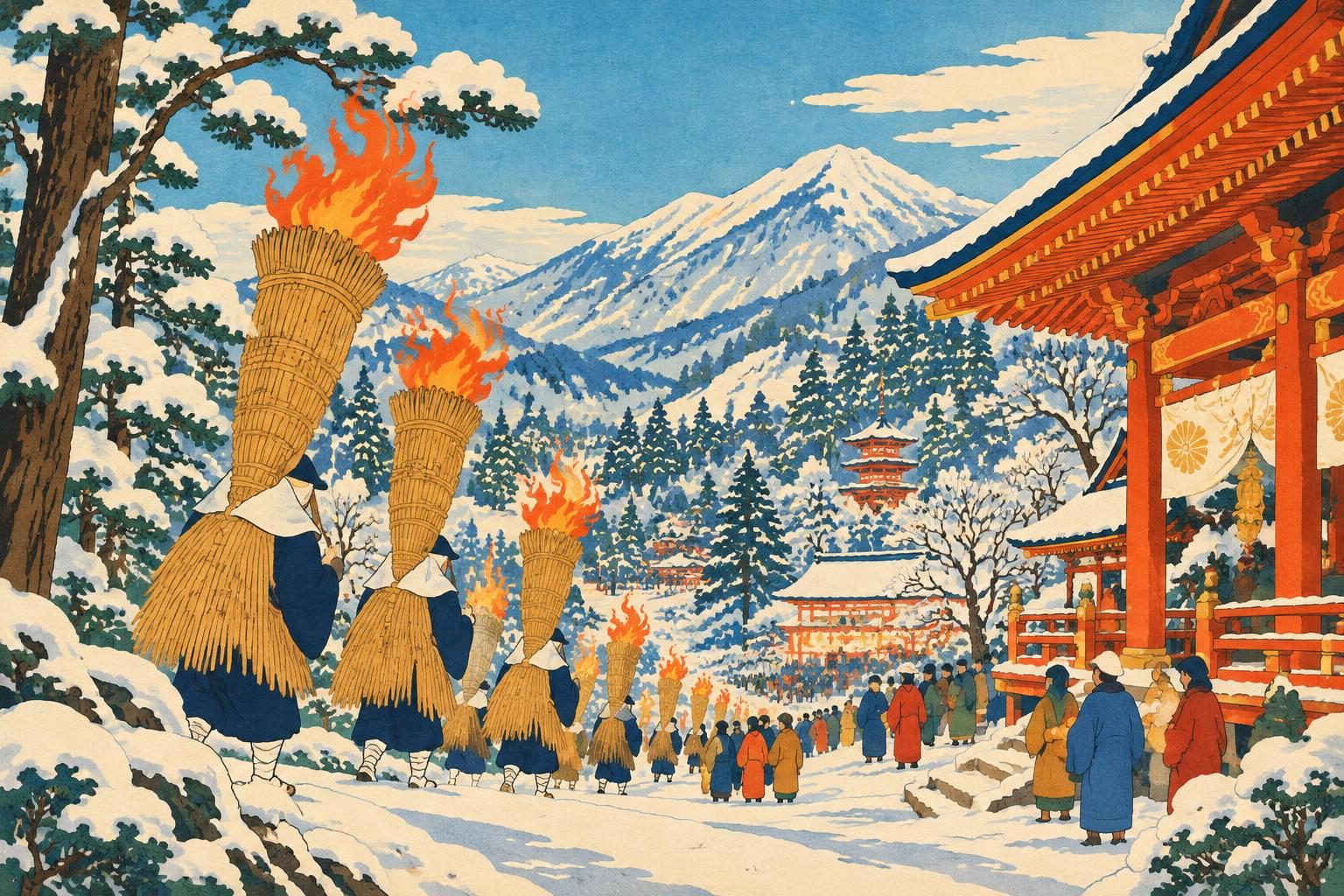
Every New Year’s Eve, the summit of Mount Haguro in Tsuruoka, Yamagata Prefecture, becomes the stage for Shoreisai, a dramatic fire festival that blends ancient yamabushi rituals with spectacular fire displays. This event is not only a captivating spectacle but also a profound cultural experience that draws visitors from all over Japan and beyond.

What Is Shoreisai? Mount Haguro’s Ancient New Year Tradition
FACT: Designation as an Important Cultural Property
Shoreisai, specifically its Great Torch Ritual, is recognized as an Important Intangible Folk Cultural Property of Japan. This designation underscores the festival’s cultural significance, highlighting its role in preserving traditional practices that have been passed down through generations. The recognition by the Agency for Cultural Affairs in Japan ensures that the festival remains a protected part of the nation’s cultural heritage, allowing future generations to continue to experience and participate in this unique tradition.
The 100-Day Winter Ascetic Training of Yamabushi
FACT: Ritual Preparation and Yamabushi Practices
The festival’s roots lie in the rigorous ascetic practices of the yamabushi, or mountain priests, who undergo 100 days of winter training known as ‘Fuyu no Mine’. This training begins around September and culminates in the Shoreisai festival. The yamabushi, referred to as Matsuhijiri, engage in this spiritual preparation to purify themselves and prepare for the rituals. This period of intense training is characterized by solitude, meditation, and physical endurance, reflecting the deep spiritual commitment of the yamabushi to their traditions and beliefs.
FACT: The Role of Yamabushi in Shoreisai
During the Shoreisai festival, the yamabushi play a crucial role in leading the rituals and ensuring their authenticity. Their presence is a testament to the enduring spiritual traditions of the Dewa Sanzan region, where Mount Haguro is located. The yamabushi’s practices are deeply intertwined with the natural environment, emphasizing harmony and respect for nature, which are central tenets of their spiritual philosophy.


The Colossal Straw Torches: Highlights of the Great Torch Ritual
FACT: The Dramatic Torch Competition
A central feature of Shoreisai is the competition involving two enormous straw torches, each shaped like tsutsugamushi, a type of demon-insect. These torches are roped, toppled, and burned by teams of young men. The ritual is both a spectacle and a symbolic act of purging the previous year’s evils and welcoming good fortune. The torches’ dramatic collapse and subsequent burning are believed to cleanse the environment and the participants, creating a fresh start for the new year.
FACT: Symbolism and Community Involvement
The construction and burning of these torches are steeped in symbolism. The tsutsugamushi shape represents the demons and negative energies that the community seeks to expel. The act of burning them signifies purification and renewal. The participation of local young men in this ritual fosters a sense of community and continuity, as they uphold traditions that have been maintained for centuries.
Divination and Fire: How the Festival Wards Off Evil
FACT: Rituals of Purification and Fortune
The burning of the torches is not merely for show; it is believed to have purifying effects, driving away evil spirits and ensuring a prosperous new year. The ritual’s competitive nature adds an element of divination, as the outcome is thought to influence the fortunes of the coming year. This aspect of the festival underscores the belief in the interconnectedness of human actions and cosmic forces, a concept deeply rooted in Japanese spiritual traditions.


Blessed Ropes and Local Protection Traditions
FACT: The Tradition of Blessed Ropes
At around 3 pm during the festival, blessed ropes are thrown into the crowd. These ropes are highly sought after, as hanging them under the eaves of a home is believed to offer protection for the entire year. This tradition underscores the community’s involvement and the festival’s role in local spiritual life. The scramble for these ropes is a lively part of the festival, reflecting the community’s collective hope for protection and prosperity.
FACT: Community and Continuity
The distribution of blessed ropes highlights the communal aspect of Shoreisai. It is a moment when the community comes together, united by shared beliefs and traditions. This practice not only reinforces social bonds but also ensures the continuity of cultural heritage, as younger generations participate and learn from their elders.
Visiting Mount Haguro in Winter: Practical Travel Tips
Visitors to Mount Haguro during Shoreisai can experience not only the festival but also the serene beauty of the winter landscape. The summit is accessible by bus, with services running from JR Tsuruoka Station to Haguro-sancho Bus Stop. For those driving, parking is available near the Zuishinmon gate. It is advisable to check the official website for current hours, fees, and access details to ensure a smooth visit.
Nearby Guide
Access
- Haguro-sancho Bus Stop (Tsuruoka) — From JR Tsuruoka Station, take the Shonai Kotsu Bus bound for Mt. Haguro for approximately 50 minutes and alight at Haguro-sancho Bus Stop, which is near the summit of Mount Haguro. Alternatively, you can take the bus to Zuishinmon Bus Stop and then walk approximately 15 minutes to the summit. official site
- Shonai Kotsu Bus (Tsuruoka) — The Shonai Kotsu Bus operates routes from Tsuruoka Station to Mount Haguro, with stops at Zuishinmon and Haguro-sancho Bus Stops. Bus schedules may vary, so it’s advisable to check the latest timetable before planning your trip. official site
- Parking at Zuishinmon-mae (Tsuruoka) — If you’re driving, parking is available near the Zuishinmon gate, which is the entrance to the pilgrimage path leading to the summit of Mount Haguro. The parking area is located across from the restaurant ‘Ishii’. official site
Nearby sights
- Five-Story Pagoda (Tsuruoka) — The Five-Story Pagoda on Mount Haguro is a National Treasure and one of the oldest in the Tohoku region. It stands amid a cedar grove near the upper entrance of the ‘Ichin-zaka’ slope on the Haguro-san pilgrimage path. details
- Sanjingo Saiden Shrine (Tsuruoka) — Located at the summit of Mount Haguro, the Sanjingo Saiden Shrine enshrines the gods of Mount Gassan, Mount Haguro, and Mount Yudono. details
- Cedar-Lined Stone Steps (Tsuruoka) — The pilgrimage path to the summit of Mount Haguro features 2,446 stone steps flanked by ancient cedar trees that are 350 to 500 years old. details
Where to stay
- Saikan Pilgrim Lodge & Restaurant (Tsuruoka) — Saikan is a Shintō pilgrim lodge situated atop Mount Haguro. It has a rich history, once serving as a temple. official site
- Haguro Sanrojo Saikan (Tsuruoka) — Haguro Sanrojo Saikan is a lodging facility located in the Haguro area, offering accommodations for visitors exploring Mount Haguro. official site
- Shukubo Inns in the Haguro Area (Tsuruoka) — The Haguro area offers various shukubo inns, which are traditional temple lodgings providing a unique cultural experience for visitors. official site
Where to eat
- Shojin-Ryori at Saikan (Tsuruoka) — Shojin-ryori is a traditional Buddhist vegetarian cuisine served at Saikan Pilgrim Lodge & Restaurant. official site
- Rikimochi Rice Cake and Matcha Green Tea (Tsuruoka) — Along the pilgrimage path, visitors can enjoy a tea house offering rikimochi rice cakes and matcha green tea. details
- Ishii Restaurant (Tsuruoka) — Ishii is a restaurant located near the Zuishinmon gate, offering local cuisine and a place to rest for visitors exploring Mount Haguro. official site


Related on JAPAN ESSENCE: Experiencing Hokkaido’s Winter New Year Rituals in Sapporo | Oji Fox Parade: Experiencing Tokyo’s Unique New Year’s Eve Kitsune Tradition
Sources
- 松例祭の大松明行事|日本遺産ポータルサイト
- Shoreisai (Haguro New Year's Eve Fire Rite) 2026 | Dec 31 – Jan 1, Yamagata | AURA
- Haguro Kanko Access
- Haguro Kanko Lodging
- ANA Japan Travel Planner
- Tsuruoka Tourism Saikan
- japan-travel.net
- www.visityamagata.jp
To explore further, visit Zenkei (禅景) for Zen-inspired onigawara art and Oni Kobo (鬼工房) for onigawara demon-tile art and charms.
毎年大晦日、山形県鶴岡市の羽黒山の頂上は、古代の山伏の儀式と壮大な火の演出が融合した松例祭の舞台となります。このイベントは、魅力的なスペクタクルであるだけでなく、日本全国や海外から訪れる人々を引きつける深い文化体験でもあります。
松例祭とは?羽黒山の古代の新年の伝統
事実: 重要文化財としての指定
松例祭、特にその大松明の儀式は、日本の重要無形民俗文化財として認められています。この指定は、世代を超えて受け継がれてきた伝統的な慣習を保存する役割を強調し、祭りの文化的重要性を示しています。日本の文化庁によるこの認識は、祭りが国の文化遺産として保護され続け、将来の世代がこのユニークな伝統を体験し参加できるようにすることを保証しています。
山伏の100日間の冬の修行
事実: 儀式の準備と山伏の実践
祭りの起源は、山伏、つまり山の僧侶の厳しい修行にあります。彼らは「冬の峰」として知られる100日間の冬の修行を行います。この修行は9月頃に始まり、松例祭で頂点に達します。松聖と呼ばれる山伏は、儀式のために自らを浄化し準備するためにこの精神的な準備を行います。この激しい修行期間は、孤独、瞑想、そして肉体的な耐久力を特徴としており、山伏がその伝統と信念に対する深い精神的な献身を反映しています。
事実: 松例祭における山伏の役割
松例祭の間、山伏は儀式を導き、その真実性を確保する上で重要な役割を果たします。彼らの存在は、羽黒山が位置する出羽三山地域の永続的な精神的伝統の証です。山伏の実践は自然環境と深く結びついており、自然への調和と敬意を強調しています。これらは彼らの精神的哲学の中心的な教義です。
巨大な藁の松明: 大松明の儀式のハイライト
事実: 劇的な松明競技
松例祭の中心的な特徴は、ツツガムシという種類の鬼虫の形をした2つの巨大な藁の松明を使った競技です。これらの松明は、若者たちのチームによってロープで倒され、燃やされます。この儀式は、スペクタクルであると同時に、前年の邪悪を浄化し、幸運を迎える象徴的な行為でもあります。松明の劇的な崩壊とその後の燃焼は、環境と参加者を浄化し、新年の新たなスタートを切ると信じられています。
事実: 象徴性と地域の関与
これらの松明の建設と燃焼は、象徴に満ちています。ツツガムシの形は、地域が追い払おうとする悪霊や負のエネルギーを表しています。それらを燃やす行為は、浄化と再生を意味します。この儀式に参加する地元の若者たちは、何世紀にもわたって維持されてきた伝統を守りながら、地域の一体感と継続性を育んでいます。
占いと火: 祭りが邪悪を追い払う方法
事実: 浄化と幸運の儀式
松明の燃焼は単なる見せ物ではなく、邪悪な霊を追い払い、豊かな新年を保証する浄化効果があると信じられています。儀式の競技的な性質は占いの要素を加え、その結果が来年の運勢に影響を与えると考えられています。この祭りの側面は、人間の行動と宇宙の力の相互関係という、日本の精神的伝統に深く根ざした概念を強調しています。
祝福された縄と地域の保護伝統
事実: 祝福された縄の伝統
祭りの午後3時頃、祝福された縄が群衆に投げ込まれます。これらの縄は非常に人気があり、家の軒下に掛けることで一年間の保護を提供すると信じられています。この伝統は、地域社会の関与と地域の精神生活における祭りの役割を強調しています。これらの縄を求めての争奪戦は祭りの活気ある部分であり、地域社会の保護と繁栄への集団的な希望を反映しています。
事実: 地域社会と継続性
祝福された縄の配布は、松例祭の共同体的な側面を強調しています。これは、共有された信念と伝統によって地域社会が一体となる瞬間です。この慣習は、社会的な絆を強化するだけでなく、若い世代が参加し、年長者から学ぶことで文化遺産の継続性を確保します。
冬の羽黒山を訪れる: 実用的な旅行のヒント
松例祭の間に羽黒山を訪れる人々は、祭りだけでなく、冬の風景の静かな美しさも体験できます。頂上へはバスでアクセスでき、JR鶴岡駅から羽黒山頂バス停までのサービスがあります。車で訪れる場合は、随神門の近くに駐車場があります。スムーズな訪問のために、最新の営業時間、料金、アクセスの詳細を公式ウェブサイトで確認することをお勧めします。
周辺ガイド
アクセス
- 羽黒山頂バス停(鶴岡) — JR鶴岡駅から羽黒山行きの庄内交通バスに乗り、約50分で羽黒山頂バス停で下車します。これは羽黒山の頂上に近いです。あるいは、随神門バス停で降りて、頂上まで約15分歩くこともできます。 公式サイト
- 庄内交通バス(鶴岡) — 庄内交通バスは、鶴岡駅から羽黒山までのルートを運行しており、随神門と羽黒山頂バス停に停車します。バスのスケジュールは変わることがあるので、旅行を計画する前に最新の時刻表を確認することをお勧めします。 公式サイト
- 随神門前駐車場(鶴岡) — 車で訪れる場合、羽黒山の頂上へ続く巡礼路の入口である随神門の近くに駐車場があります。駐車場はレストラン「石井」の向かいにあります。 公式サイト
周辺の見どころ
- 五重塔(鶴岡) — 羽黒山の五重塔は国宝であり、東北地方で最も古いものの一つです。羽黒山巡礼路の「一の坂」上部入口近くの杉林の中に立っています。 詳細
- 三神合祭殿(鶴岡) — 羽黒山の頂上に位置する三神合祭殿は、月山、羽黒山、湯殿山の神々を祀っています。 詳細
- 杉並木の石段(鶴岡) — 羽黒山の頂上への巡礼路には、350年から500年の古い杉の木に囲まれた2,446段の石段があります。 詳細
泊まる
- 斎館(鶴岡) — 斎館は羽黒山の頂上に位置する神道の巡礼宿で、かつては寺院としての歴史があります。 公式サイト
- 羽黒山麓斎館(鶴岡) — 羽黒エリアに位置する宿泊施設で、羽黒山を探索する訪問者に宿泊を提供しています。 公式サイト
- 羽黒エリアの宿坊(鶴岡) — 羽黒エリアには、訪問者にユニークな文化体験を提供する伝統的な寺院宿泊施設である様々な宿坊があります。 公式サイト
食べる
- 斎館の精進料理(鶴岡) — 精進料理は、斎館巡礼宿で提供される伝統的な仏教の菜食料理です。 公式サイト
- 力餅と抹茶(鶴岡) — 巡礼路沿いには、力餅と抹茶を提供する茶屋があります。 詳細
- 石井レストラン(鶴岡) — 石井は随神門の近くに位置するレストランで、地元の料理を提供し、羽黒山を探索する訪問者に休憩の場を提供しています。 公式サイト
Related on JAPAN ESSENCE: Experiencing Hokkaido’s Winter New Year Rituals in Sapporo | Oji Fox Parade: Experiencing Tokyo’s Unique New Year’s Eve Kitsune Tradition
Leave a Reply