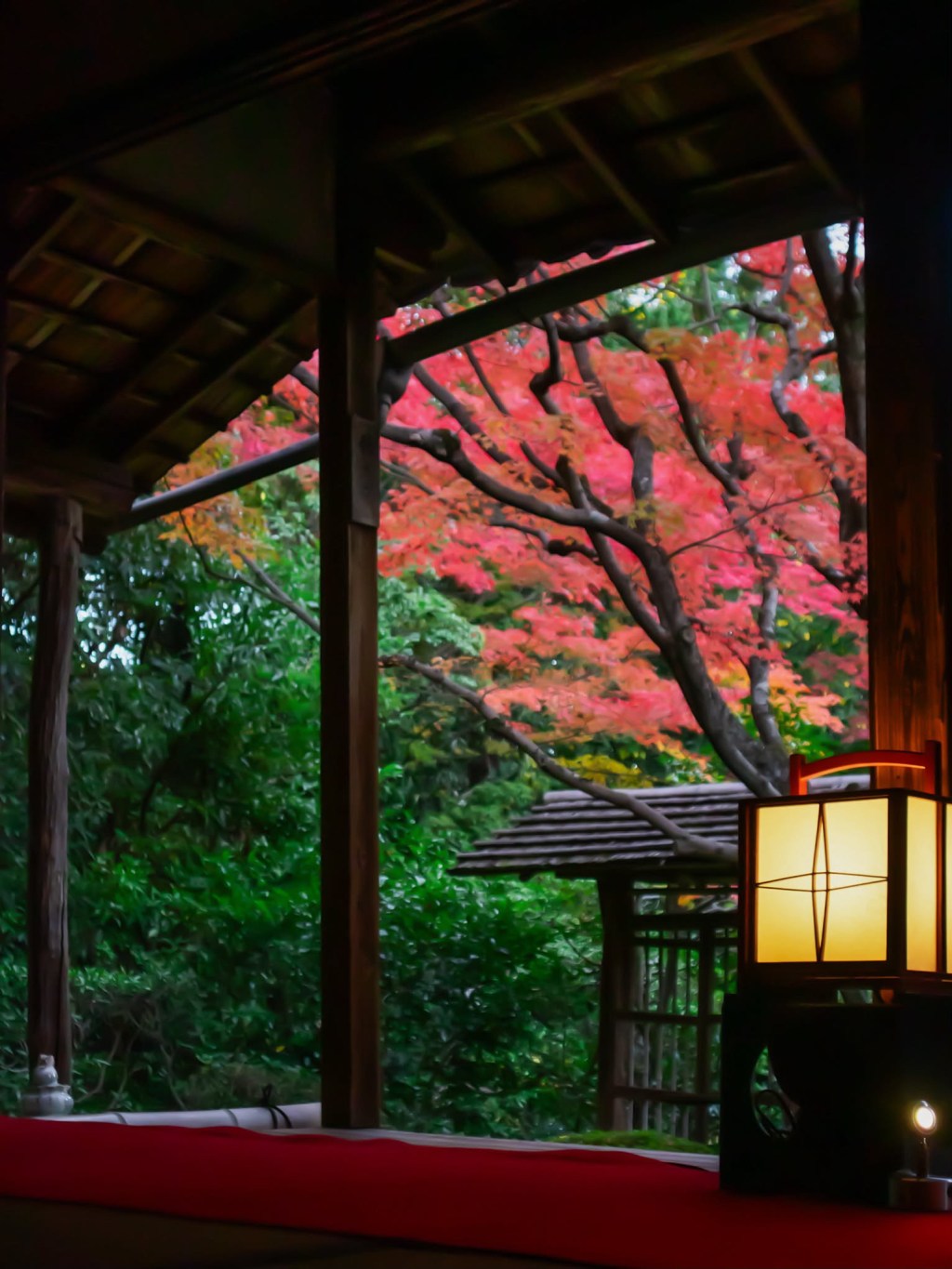
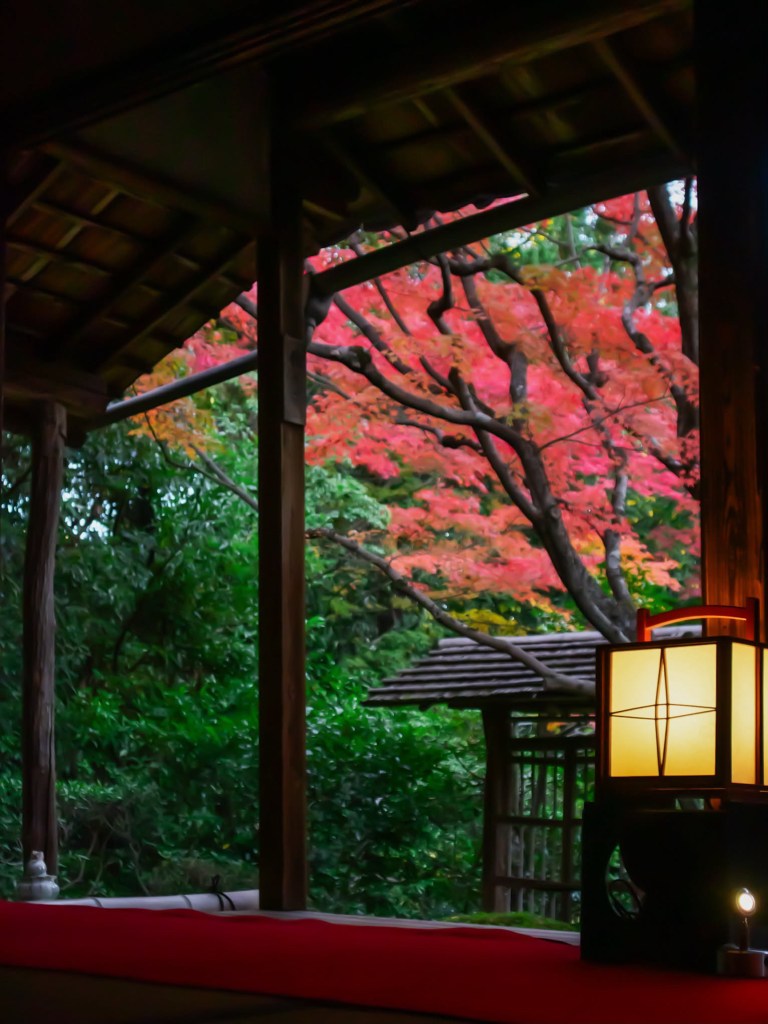
Scarlet maple leaves arch over a small roofed gate. Below them, a wall of deep evergreen; in front, dark wooden pillars, a red felt runner along the veranda, and a paper lantern glowing amber in the dusk. This single photograph, shared by the owner of this site, captures what many people travel to Kyoto for in autumn: not a crowd-filled viewpoint, but a quiet moment where color, wood and light meet.
日本語版はこちら:桂春院の紅葉と行灯
Where is this? Keishun-in at Myoshinji
The scene has been identified, with high confidence, as the veranda facing the Wabi Garden (侘の庭) at Keishun-in (桂春院), a sub-temple of Myoshinji in Hanazono, Ukyo Ward, Kyoto. The roofed gate, the shape of the maple branches, the pillars, the red runner and the lantern match published photographs of the temple. (The image file has no GPS or date data, so we do not claim when it was taken.)
What is a sub-temple? Large Zen head temples in Japan are surrounded by smaller temples within or beside their precincts, called tatchū (塔頭, sub-temples). Each has its own buildings, gardens and history. Myoshinji, head temple of the Myoshinji branch of Rinzai Zen, has many; Keishun-in is one of the few open to visitors all year. (Keishun-in official)
History (from the temple’s official site): Keishun-in was founded in the Azuchi-Momoyama period by Tsuda Hidenori, a grandson of Oda Nobunaga; the temple’s official pages give the year as 1598. It was later revived by Ishikawa Sadamasa, who served both Toyotomi Hideyoshi and Tokugawa Ieyasu. The temple says its study hall (shoin) was moved here from Nagahama Castle, and that its buildings and interiors have kept their form for about 400 years. Some tourism pages give different founders or dates; we follow the temple. Its front gate, main hall and study hall are Kyoto Prefecture Tangible Cultural Properties, and its gardens are a nationally designated Place of Scenic Beauty and Historic Site. (Keishun-in official / official special-program page)
The four gardens
The temple attributes its four gardens to Gyokuenbō, a monk-gardener and disciple of the tea master Kobori Enshū. Each shows a different scene; the temple itself describes them together as the path of a trainee toward awakening, which we report as the temple’s own interpretation. Per the official garden page (Garden history):
- Seijō no Niwa (清浄の庭) — a small courtyard dry garden north of the main hall, with a stone-arranged waterfall and a stream of white sand.
- Wabi no Niwa (侘びの庭) — the garden in our photo. It is a roji (tea-garden path) leading from the study hall to the hidden tea room Kihaku-an (既白庵). The Baiken-mon gate and a saru-do wicket divide it into inner and outer sections, and a moss-covered stone water basin (tsukubai) sits half hidden.
- Shii no Niwa (思惟の庭) — east of the main hall; stepping stones lead from the Baiken-mon gate through a roji-like garden with scattered stones.
- Shinnyo no Niwa (真如の庭) — south of the main hall; maples in front of satsuki and Kirishima azaleas and Japanese andromeda, over a carpet of haircap moss with small stones set in a 7-5-3 style arrangement.
Kihaku-an tea room: the official site describes Kihaku-an as a place that is normally completely closed to the public. A regular admission ticket does not include entry; the temple has shown it only through separate reserved programs. Ordinary visitors see the gardens from the buildings and veranda. (Keishun-in official)
Other highlights: inside, you walk through the cultural-property buildings themselves. The official site highlights the gold-leaf sliding-door (fusuma) painting “Pine Trees and Crescent Moon” (金碧松三日月図) by the Edo-period painter Kano Sansetsu, whose works are held by museums abroad, as well as surviving furnishings. Matcha with a seasonal sweet (¥800) can be ordered—a simple way to sit and look at the gardens. (Keishun-in official)
Why leaves turn red and yellow
Yellow is already in the leaf: as chlorophyll breaks down in autumn, carotenoid pigments become visible. Red is different—it comes from anthocyanins that the leaf produces in autumn. Sunny days, cold nights and moderate moisture all affect how vivid the color becomes. (National Museum of Nature and Science)
Momiji or kaede?
Japanese has two words for these trees. Momiji is explained as coming from the old verb momizu, “to change color” (of leaves). Kaede is explained as coming from kaerude, “frog’s hand,” for the leaf’s shape. The two words overlap heavily rather than naming completely separate plant groups. (Ministry of the Environment, Kinki Regional Office)
Momijigari: “hunting” without hunting
Momijigari literally means “autumn-leaf hunting,” but nothing is caught: it means going out to the hills to enjoy the colors, a broadened sense of kari (JNTO). Appreciation of autumn leaves appears in classics such as the Kokin Wakashū and The Tale of Genji, and by the Edo period the custom had spread to ordinary townspeople, as woodblock prints show. It has no single founding date or inventor. (JNTO / National Diet Library)
Five autumn-leaf spots across Japan
Note: the periods below are typical-year guides only—not a 2026 forecast or current conditions. Timing changes with weather and altitude. These are separate places from Keishun-in.
- Ginsendai, Daisetsuzan (Hokkaido) — usually mid to late September; red and yellow mountainsides against dark conifers. (Visit Hokkaido)
- Oirase Gorge (Aomori) — usually late October to early November; a stream, waterfalls and mossy rocks under the leaves. (Aomori Tourism)
- Korankei (Aichi) — usually November; maples around Mt. Iimori. (Aichi Now)
- Kiyomizu-dera (Kyoto) — Kyoto’s autumn usually centers on mid to late November, varying by year and place. (JNTO / Kyoto City Tourism, typical guide)
- Momijidani Park, Miyajima (Hiroshima) — usually November; maples at the foot of Mt. Misen among evergreens. (Miyajima Tourist Association)
Area guide: visiting Keishun-in
Address: 11 Hanazono Teranonaka-cho, Ukyo-ku, Kyoto. Access: Randen (Keifuku) Kitano Line, Myoshinji Station; or bus to “Myoshinji Kitamon-mae,” about 5 minutes on foot (Kyoto City Bus 8, 10, 26 or JR Bus from Kyoto Station, per the temple). Hours/fees (as listed on the official site, checked 16 Oct 2026): 9:00–17:00 (winter until 16:30); admission ¥500; matcha with seasonal sweet ¥800. Closures for ceremonies are possible—always check the official site before visiting. No special autumn night opening was found on the official site.
Manners: stay on the veranda and paths, keep voices low, and follow the temple’s photography rules.
Nearby: the vast Myoshinji precinct itself; Ryoan-ji with its famous rock garden; and Ninna-ji, a World Heritage temple. Stay: central Kyoto (Shijo/Karasuma) or around Kyoto Station gives easy bus access; see Kyoto City Official Travel Guide. Food: the temple’s own matcha and seasonal sweet is a natural pause; the Hanazono area also has places serving Buddhist vegetarian (shōjin) cuisine.
Interested in another side of Kyoto craft culture? Visit our sister site Oni Koubou.
Letting the season turn slowly
Autumn in Japan is often chased from forecast to forecast. A place like Keishun-in suggests another way: sit at the edge of a veranda, let the lantern warm the corner of your eye, and watch one maple turn. The best view may simply be the one you have time to stay with.
Sources: Keishun-in official (keishunin.com: top, garden and special-program pages); National Museum of Nature and Science; Ministry of the Environment Kinki Regional Office; JNTO; National Diet Library; Visit Hokkaido; Aomori Tourism; Aichi Now; Kyoto City Tourism; Miyajima Tourist Association. Photo: courtesy of the site owner.


Leave a Reply