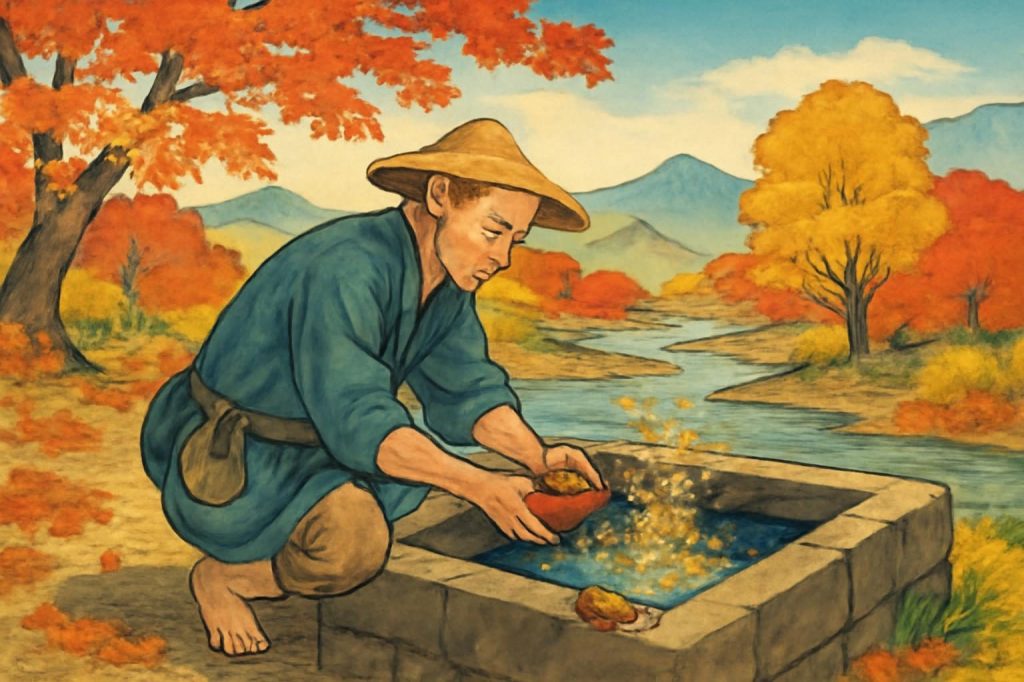
A small spring beside Kenrokuen offers a different way into Kanazawa’s story. Before thinking about grand gardens or glittering objects, imagine someone washing the earth from freshly dug yams. That ordinary action sits at the heart of the city’s best-known origin legend. Following it leads to three distinct places: the spring near Kanazawa Shrine, a neighborhood associated with the legendary farmer, and a museum that explains the city’s later gold-leaf heritage.
The legend: yams, gold and the name Kanazawa
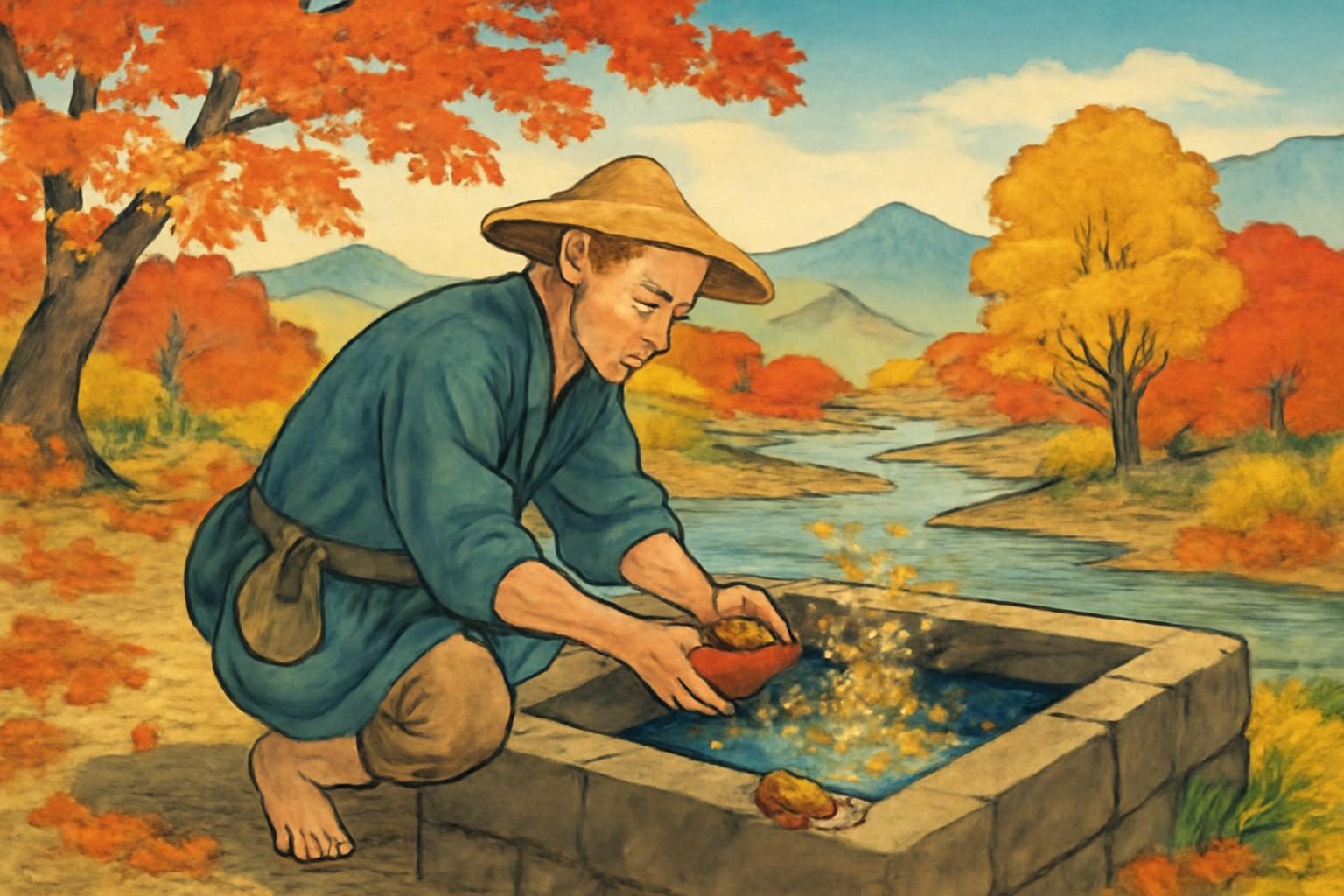
The Kanazawa City Tourism Association identifies the spring as Kinjo Reitaku, written 金城霊澤. Its account says that Imohori Togoro washed yams in the water and found grains of gold. The place came to be known as a gold-washing stream, traditionally explaining the name Kanazawa. This is a local origin legend; it should not be read as a documented discovery of a gold deposit.
Kanazawa Shrine’s own telling adds an important detail: Togoro, a poor but honest farmer from Yamashina, shared the gold with people in need. The story therefore gives generosity a place alongside good fortune. When reading or retelling it, keep that human choice in view rather than reducing the tale to a promise of personal wealth. The shrine’s account does not require us to picture manufactured gold leaf rising magically from the water.
Another version, recorded in a 2017 Kanazawa Literary Hall storytelling report, brings Togoro’s wife into the discovery. After he gives away the valuables she brought into their marriage, he explains that gold can be found where he washes yams. The couple subsequently find it together. Such differences are part of reading folklore: a short shrine account and a longer storytelling version can emphasize different relationships and choices. Comparing them makes the tale richer without requiring every detail to belong to a single fixed narrative.
Finding the spring and keeping the places separate
Kinjo Reitaku is beside Kenrokuen, near Kanazawa Shrine, at 1-3 Kenroku-machi. The tourism association lists a walk of about five minutes from the Hirosaka / 21st Century Museum bus stop, or about one minute from the National Crafts Museum / Prefectural Museum of Art stop on the Kikugawa route of the Kanazawa Flat Bus. Use its official location guide before setting out. Searching for the spring’s Japanese name is more precise than searching only for a ‘gold well.’
Togoro Shrine is a different stop in Yamashina. The Kanazawa Literary Hall’s folklore reports associate that neighborhood and shrine with Togoro’s legendary home and the tradition of his hoe-hanging pine. Treat the residence association as tradition, not an excavated and proven address. A visit there can extend a folklore-focused trip, but it is not the same place as the spring beside Kenrokuen. Mark them separately on your map and allow for the journey between them.
Kenrokuen: a garden with its own history
The surrounding garden has a historical timeline of its own. Ishikawa Prefecture’s garden history traces the usual starting point to Maeda Tsunanori’s villa and garden in 1676. Successive generations reshaped the grounds; the name Kenrokuen was adopted in 1822, and the garden was fully opened to the public in 1874. Those dates describe the garden’s development, rather than dating the much older setting imagined in Togoro’s story. Keeping the two timelines separate makes both easier to appreciate.
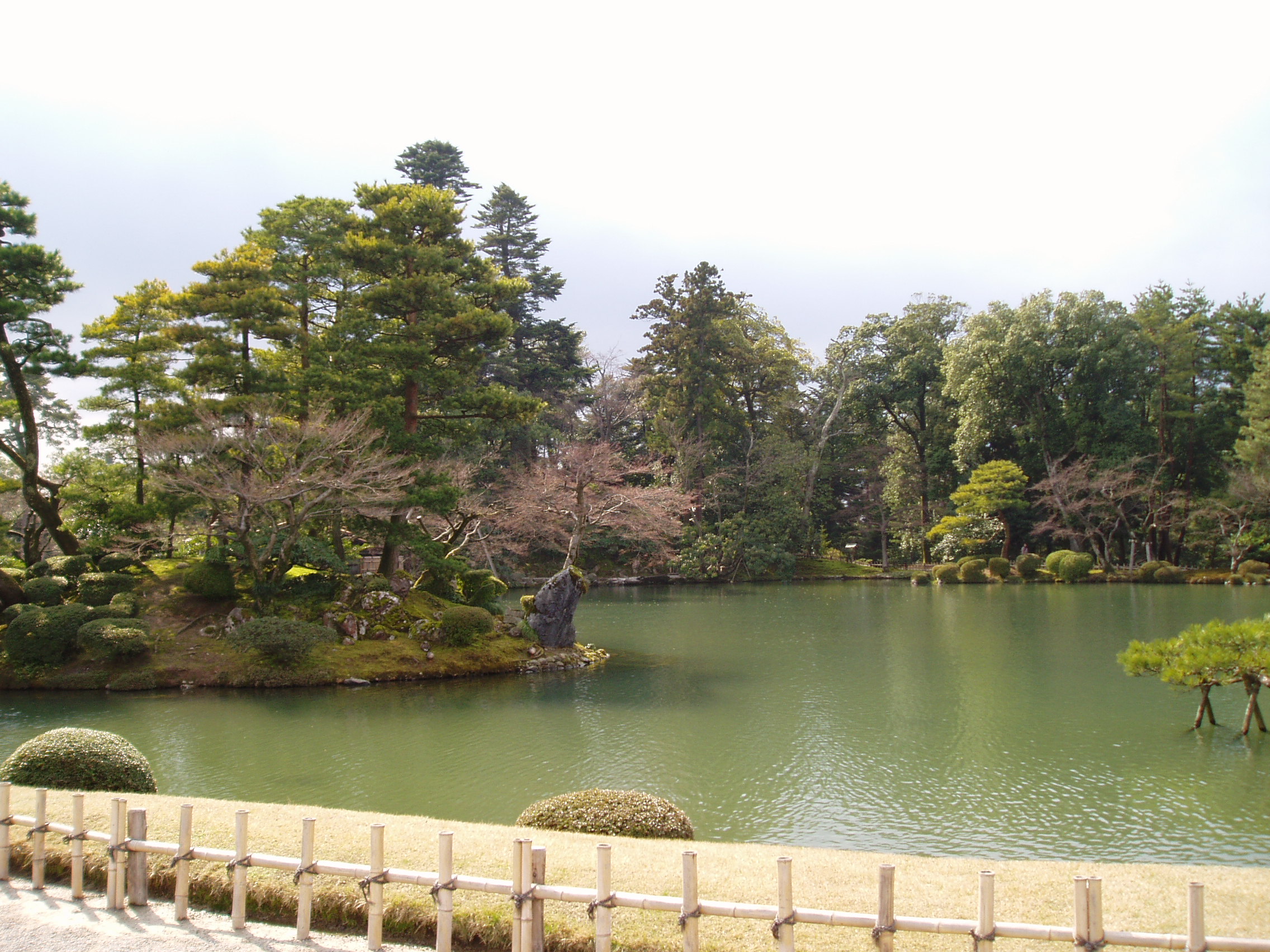
The prefecture describes Kenrokuen as a strolling garden shaped around ponds, landscaped hills, trees and places to pause. Let the changing views guide your walk. Look across water from more than one position, notice how a path reveals or conceals the next scene, and leave time simply to stop. This is a rewarding companion to the spring visit: the legend invites imaginative reading, while the garden asks for close attention to the landscape in front of you.
Gold-leaf heritage: a separate historical story
Kanazawa’s association with gold also has a craft-history dimension. The municipal Yasue Gold Leaf Museum explains that the precise beginning of local leaf production is unclear, although documentary evidence reaches the late sixteenth century. Its account follows later regulation and changing circumstances rather than attributing the industry to Togoro. The shared image of gold makes a compelling theme for a visit, but it is not evidence that the legend created or sustained the trade.
For a museum stop, the Yasue Gold Leaf Museum visitor guide lists the address as 1-3-10 Higashiyama. Its current hours are 9:30 a.m. to 5 p.m., with last admission at 4:30 p.m.; regular closure is Tuesday, moving to the next weekday when Tuesday is a public holiday. Exhibition-change closures also apply. Check the calendar before committing to a route. This gives the day’s theme a useful second perspective through an institution devoted to the city’s gold-leaf heritage.
Regional guide: planning an unhurried visit
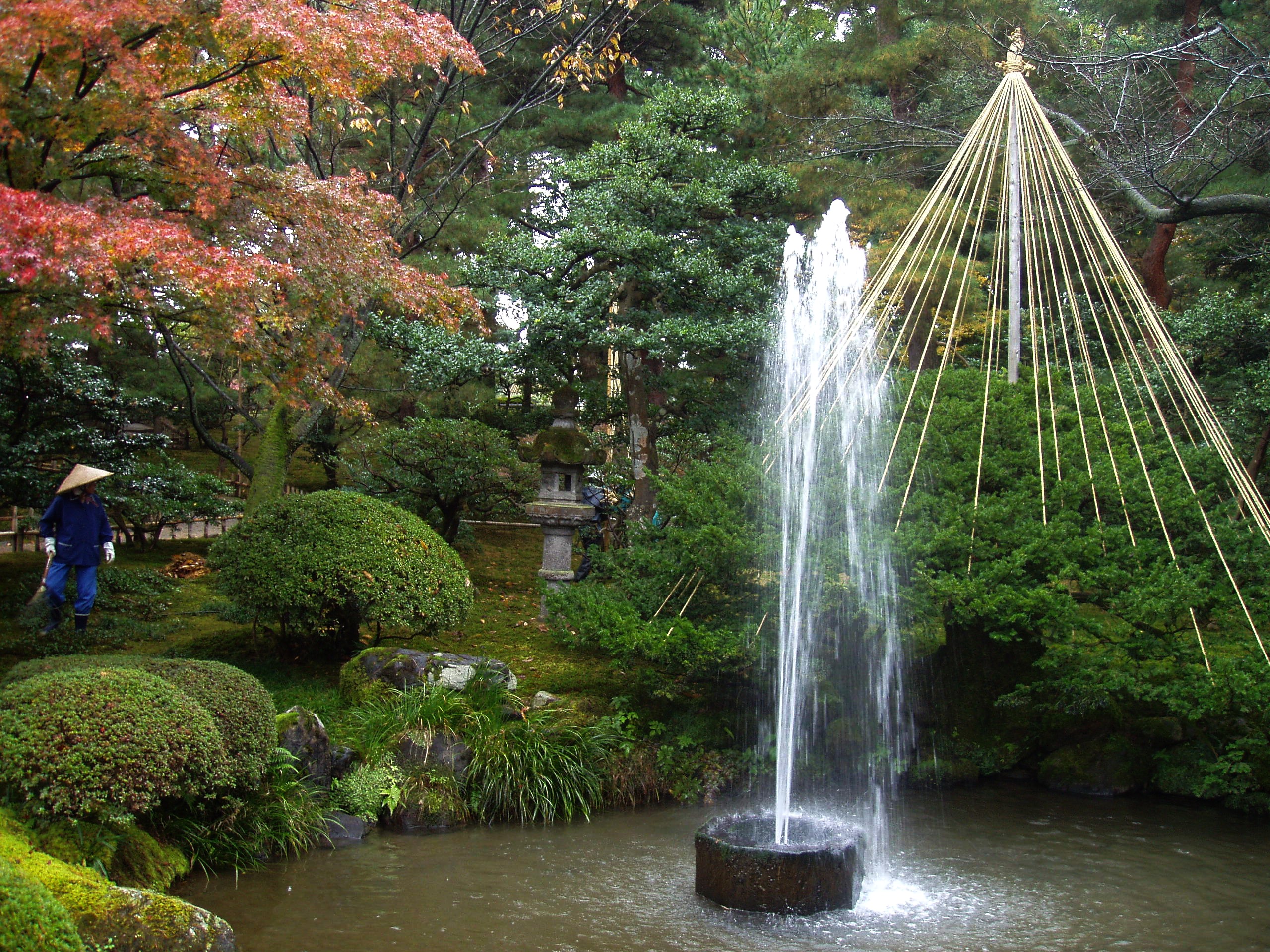
Start with Kinjo Reitaku and nearby Kanazawa Shrine, then choose how much time to give the garden. The prefectural sights map identifies the spring alongside other points of interest, including the fountain and Kasumigaike Pond. Our photographs show those garden surroundings, not the gold-washing spring itself. Match each image to its caption rather than using it as a navigation landmark. The map is especially useful for understanding why nearby attractions can still require different paths or entrances.
For an October visit, note the garden’s seasonal change in opening times. The official visitor information lists 7 a.m. to 6 p.m. through October 15, then 8 a.m. to 5 p.m. from October 16, with final admission thirty minutes before closing. These are garden hours, not a promised schedule for every nearby shrine or facility. The same page warns about slopes and slippery gravel paths and links to an accessible recommended route. Comfortable shoes and a realistic pace will serve you better than a tightly packed checklist.
If you continue to Higashiyama for the museum, treat it as a separate stage of the day. If the Yamashina tradition is your main interest, leave room for that journey instead of trying to cover every location. At the spring and shrines, follow posted guidance, keep paths clear and respect people who are there to worship. Avoid touching or entering water features simply to recreate a scene from the tale. A good folklore walk leaves the place undisturbed and gives the story room to remain a story.
Before leaving, consider what each stop has added: a story about unexpected fortune, a landscape shaped over generations, and a craft tradition with a documented but complex past. You do not have to collapse them into one explanation of Kanazawa. Their different kinds of evidence, and the ways residents continue to remember them, make the city more interesting. The spring is a modest starting point for that broader curiosity.
Official local sights map · Spring location and transport · Museum access and closure calendar
Related on JAPAN ESSENCE: Exploring Tōno: The Heart of Japanese Folklore and Yokai Legends | Exploring the Killing Stone of Nasu: The Legend of Tamamo-no-Mae
Sources
Kanazawa Literary Hall: 2017 storytelling report / 金沢文芸館「平成29年度 文芸館だより」
Kanazawa City Tourism Association: Kinjo Reitaku / 金沢市観光協会「金城霊澤」
Kanazawa Shrine: grounds guide / 金澤神社「周遊案内」
Kanazawa Literary Hall: 2022 folklore reports / 金沢文芸館「令和4年度 文芸館だより」
Ishikawa Prefecture: About Kenrokuen / 石川県「兼六園とは」
Ishikawa Prefecture: Kenrokuen history / 石川県「兼六園の歴史」
Ishikawa Prefecture: Kenrokuen visitor information / 石川県「兼六園 利用案内」
Ishikawa Prefecture: Kenrokuen sights map / 石川県「見どころマップ」
Yasue Gold Leaf Museum: Kanazawa and gold leaf / 安江金箔工芸館「金沢と金箔」
Yasue Gold Leaf Museum: visitor information / 安江金箔工芸館「ご利用案内」
Sources and visitor information checked on October 8, 2026. Opening arrangements may change; consult each official page before visiting.
For another encounter with Japanese guardian imagery, explore Oni Kobo (鬼工房) and the Kyoto experience offered by Kawarakoubou (瓦工房).


Leave a comment