Walk through Higashiyama on an autumn afternoon and the air is already cooler than it was at noon. Maple leaves beyond a paper screen have started to flush. Somewhere nearby, a temple bell settles into silence. And above a courtyard wall, at the blunt end of a ridge line, a face is watching: teeth bared, brows knotted, silver-grey clay catching the late light.
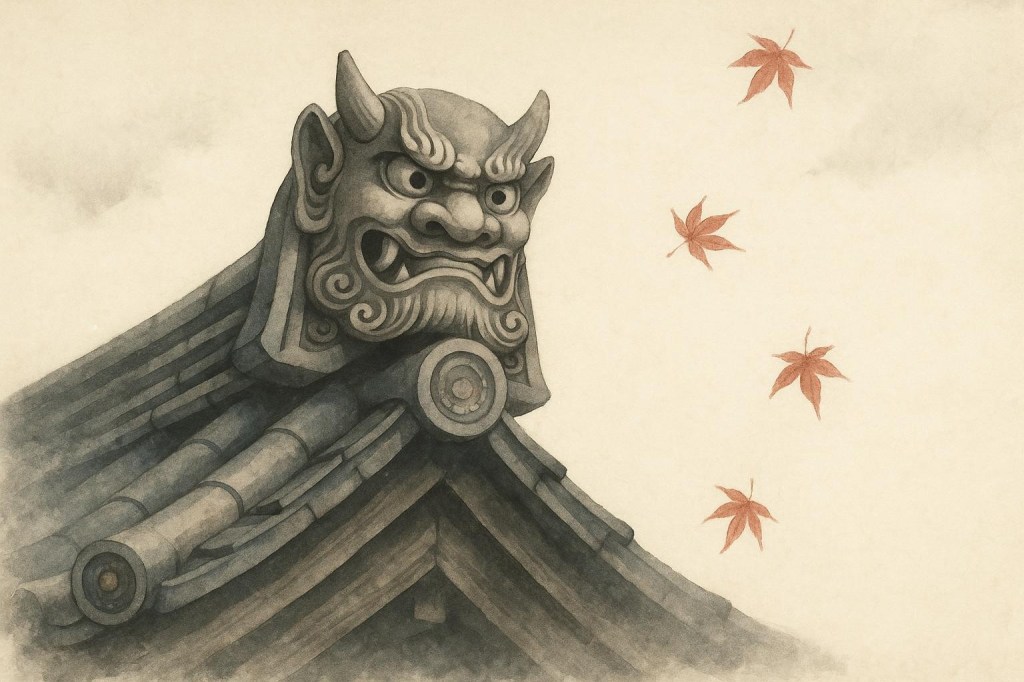
That face was an onigawara: a Japanese demon-faced roof tile. Not a Halloween mask. Not a joke. A piece of architecture that has been finishing, weatherproofing, and — in the old way of thinking — guarding Japanese roofs for centuries.
If you are traveling to Kyoto this autumn, you will walk under dozens of them without knowing. This is a guide to seeing them clearly — and, if you like, to shaping a small one yourself from clay, then waiting for the kiln to turn it into something that can sit in your home.
What onigawara are (and what “demon” really means)
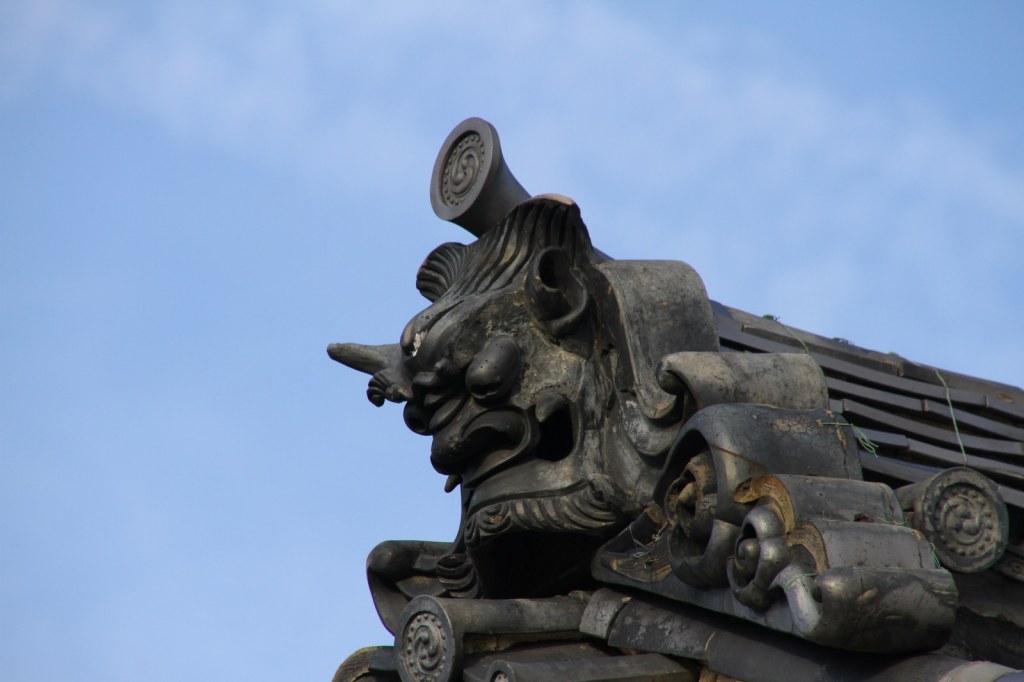
Onigawara (鬼瓦) is written with the characters for oni (ogre / demon) and kawara (roof tile). The literal English “demon roof tile” sounds ominous. In practice, the name covers a whole family of ridge-end tiles — the special tiles fitted where a main ridge or a descending ridge terminates.
Some onigawara show a fierce face. Others show lotus blossoms, clouds, family crests, or animals, because the motif is not always an oni. Still, the demon face is the image most travelers remember — and the one that carries the strongest story.
That story is not “evil lives on the roof.” It is closer to this: a terrifying face can frighten away misfortune. The same protective instinct that put fierce guardian statues at temple gates put staring eyes on the ridge. The tile also does ordinary work — it closes a vulnerable junction of the roof against rain and wind. Symbol and structure sit in the same piece of fired clay.
Japanese tile-making has a surprisingly precise starting point. According to the Nihon Shoki, Japan’s oldest official chronicle, in 588 the Korean kingdom of Baekje sent temple builders, a painter, and four “tile masters” to help build Asuka-dera, the country’s first full-scale Buddhist temple. And the earliest ridge-end tiles were not demons at all. Most carried lotus flowers. Only from the Nara period onward did the fierce face become the dominant design, and the name oni-gawara stuck. Today the word covers every ridge-end tile, face or no face. Some even carry the character for “water” (水), a quiet wish that fire would stay away.
So when you hear “demon,” hear guardian. The face is meant to stand between the house and harm.
How to spot them when you walk Kyoto’s temples
Kyoto trains the eye downward — stone paths, moss, shop fronts, matcha. Onigawara ask you to look up.
Try this on your next temple or machiya walk:
- Find the main ridge — the highest horizontal line of the roof.
- Follow it to either end. That blunt termination is where a ridge-end tile often sits.
- On larger temple halls, check the ends of descending ridges too, where the roof steps down toward the eaves.
- Notice color. Traditional sangawara-style tiles often read as dark grey to soft silver after years of weather. Fresh clay and aged roofs do not look the same.
- Do not expect every ridge end to show teeth. A crest, a lotus, or a cloud scroll is still part of the same family of finishing tiles.
Autumn helps. After summer haze thins, and before winter snow softens every outline, the silhouette of a Kyoto roof becomes very readable against a clear sky. Stand in a courtyard after the tour groups pass. Let your gaze climb the tiles one course at a time until the ridge ends. The face — if there is one — will feel less like decoration and more like a presence that has been working overtime for a very long time.
Inside temple halls you will meet other guardians — painted dragons on ceilings, stone deities in the garden, fierce protectors at the gate. Onigawara belong to that same vocabulary of watchfulness. Different materials, same old wish: may this place be kept safe.
Making a small onigawara with your hands
Seeing a face on a roof is one kind of encounter. Pressing clay into a face of your own is another.
A few tile workshops in Japan let visitors shape a small onigawara themselves, and Kyoto has at least one near the old temple districts of Higashiyama. The flow is usually simple:
Clay first. It cools the fingers, sticks under the nails, and smells faintly of earth. Wear clothes that can get dirty; this is not a white-gloves craft.
Then the face. With a craftsman’s guidance, you shape a compact ridge-end tile with a demon expression. It is not a copy of a temple giant, just a small original that only your hands made.
Then the wait. Your tile is finished afterward in silver using a traditional smoking technique, so you usually leave without your piece. It follows you home later, in the soft silver-grey of a Kyoto roof. That pause is part of the craft. Clay does not hurry.
When it arrives, set it by a doorway or on a shelf. The same protective idea that once lived only on temple ridges can sit quietly indoors, as a small guardian you shaped yourself.
Practical tips
- Book ahead. Small workshops run on reservations, and autumn weekends in Kyoto fill fast.
- Pair it with a temple walk. Look up at the ridges in the morning, then make your own tile in the afternoon.
- Expect limited English. Gestures and patience do a lot of the work, and that is part of meeting a working craftsman.
- Plan for shipping. You leave without your piece; the finished tile follows you home.
A face on the ridge, a face in your hands
Kyoto’s roofs are easy to treat as background. Once you learn the word onigawara, the skyline changes. Every temple walk becomes a scavenger hunt for ridge ends. Every demon face becomes a reminder that Japanese architecture never separated beauty from protection.
And if you take an afternoon in Higashiyama to press clay into a frown and a pair of staring eyes, you will understand something a photograph cannot give you: the weight of the material, the stubbornness of a mouth you shaped too narrow and then opened again, the strange tenderness of waiting for fire to finish what your fingers began.
When the silver tile finally reaches you, set it where morning light finds it. You will have carried a piece of Kyoto’s roof tradition home — not as a souvenir sticker, but as a guardian you met halfway.
Sources & Further Reading
- Nara National Museum — Terminal ridge-end tile (onigawara) with lotus blossom motif, Asuka period
- Kyushu National Museum (e-Museum, National Institutes for Cultural Heritage) — Ridge-end tile depicting a demon’s face in relief
- Kyoto National Museum (e-Museum, National Institutes for Cultural Heritage) — Ridge-end Tile (Onigawara) from the Imperial Palace of Ancient Kyoto
- Gangoji Temple (successor of Asuka-dera), Nara — History (chronological table)
- JAANUS (Japanese Architecture and Art Net Users System) — onigawara 鬼瓦
- W. G. Aston (trans.), Nihongi: Chronicles of Japan — Book XXI (Wikisource)
Visit / make in Kyoto
Kawarakoubou Youya (瓦工房YOU家) — workshop, gallery, and kawara craft in Higashiyama, near Gojo Ohashi.
- Workshop & gallery site: kawarakoubou-y.com
- Onigawara-making experience (reservation): kawaraexperience.com
- Adult experience: ¥14,000 tax included


Leave a comment