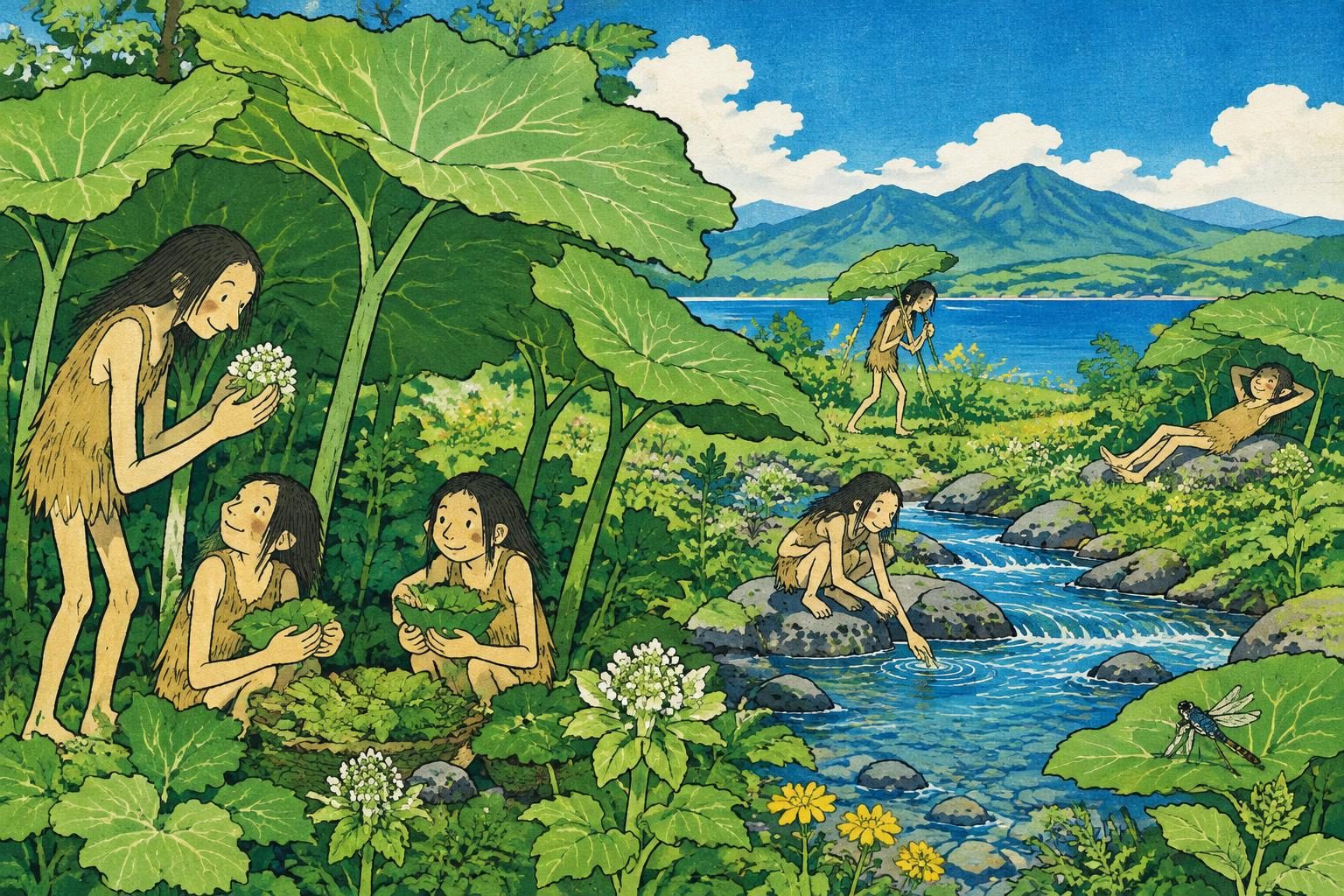
In Shiraoi, Hokkaido, the legend of the Koropokkuru—a mysterious race of little people who lived under butterbur leaves—continues to capture the imagination of many. This tale, deeply rooted in Ainu folklore, offers a glimpse into the rich cultural tapestry of Japan’s northernmost island.

Who Are the Koropokkuru in Ainu Folklore?
LEGEND: The story of the Koropokkuru
According to Ainu folklore, the Koropokkuru were a race of small, human-like beings who inhabited Hokkaido long before the Ainu people arrived. They were said to be only a few feet tall, with long arms and legs, and lived under the large leaves of the butterbur plant, which they used as makeshift shelters. The name ‘Koropokkuru’ itself is derived from the Ainu words ‘koro’ (meaning ‘people’), ‘pok’ (meaning ‘under’), and ‘kuru’ (meaning ‘leaf’), thus translating to ‘people under the leaves’. This etymology reflects their intimate connection with nature, emphasizing their small stature and their resourcefulness in using the natural environment for protection and shelter.
LEGEND: Silent trade with the Ainu
Local tradition holds that the Koropokkuru engaged in a form of silent trade with the Ainu. The Koropokkuru would leave fish and game on the riverbanks for the Ainu, who in return would leave goods such as rice and sake. This exchange was conducted without direct contact, as the Koropokkuru were said to be shy and wary of humans. However, one story recounts how an Ainu man, curious about these mysterious benefactors, hid near the riverbank and managed to catch a Koropokkuru. The captured being was so ashamed of being seen that it vanished, and from that day on, the Koropokkuru were never seen again. This tale underscores the delicate balance and mutual respect that once existed between the Koropokkuru and the Ainu, highlighting the fragility of their relationship.
The Meaning Behind the Name: Life Under Butterbur Leaves
FACT: The significance of butterbur leaves
The butterbur plant, known as ‘fuki’ in Japanese, plays a significant role in the legend of the Koropokkuru. These large, broad leaves provided the perfect cover for the diminutive Koropokkuru, symbolizing their connection to the natural world and their resourcefulness in using the environment to their advantage. The butterbur plant is native to Hokkaido and is commonly found in damp, shaded areas, which aligns with the traditional habitat of the Koropokkuru as described in Ainu folklore. The choice of the butterbur leaf as their shelter not only highlights their small size but also their adaptability and harmonious relationship with nature.
FACT: The cultural symbolism of the butterbur
Beyond its practical use as a shelter, the butterbur leaf holds cultural significance. In many cultures, plants and their characteristics are often imbued with symbolic meanings. For the Koropokkuru, the butterbur leaf represents protection and invisibility, allowing them to live undetected by the larger world. This symbolism is a testament to their elusive nature and the mystery that surrounds them in Ainu folklore.


Why Did the Koropokkuru Disappear?
LEGEND: The end of the Koropokkuru
Various accounts explain the disappearance of the Koropokkuru. One popular version suggests that after the incident of being seen by an Ainu, the Koropokkuru felt their privacy was violated and chose to leave the area. Another theory posits that the arrival of the Ainu and subsequent changes in the environment led to their decline. Despite these tales, the Koropokkuru remain a cherished part of Ainu oral tradition, symbolizing the mystery and allure of the unseen world. These stories serve as a reminder of the delicate balance between human expansion and the preservation of mythical and natural worlds.
Connecting Folklore to History: Stone Age Pit-Dwellings
FACT: Archaeological connections
Some researchers suggest a historical basis for the Koropokkuru legend, linking it to the ancient Jomon people who inhabited Japan during the Stone Age. The Jomon were known for their pit-dwellings, which could have inspired the idea of small beings living close to the earth. While there is no direct evidence connecting the Jomon to the Koropokkuru, the similarities in lifestyle and dwelling types provide an intriguing possible connection between folklore and history. This potential link invites further exploration into how ancient peoples may have influenced the myths and legends that have been passed down through generations.
FACT: The Jomon culture and its influence
The Jomon culture, characterized by its unique pottery and pit-dwelling lifestyle, represents one of the earliest known cultures in Japan. The possibility that the Koropokkuru legend could be rooted in the Jomon way of life adds a layer of historical depth to the folklore. It suggests that the stories of the Koropokkuru may have been inspired by real historical interactions, blending myth with the reality of ancient human habitation in Hokkaido.


Exploring Ainu History and Culture at Upopoy in Shiraoi
FACT: Ainu cultural preservation
For those interested in learning more about Ainu culture and the legend of the Koropokkuru, the Upopoy National Ainu Museum and Park in Shiraoi is a must-visit. This cultural complex is dedicated to preserving and promoting Ainu heritage, offering visitors a chance to explore exhibits on Ainu history, art, and traditions. The museum provides valuable insights into the rich cultural legacy of the Ainu people and their folklore, including the stories of the Koropokkuru. Visitors can engage with interactive displays and participate in cultural workshops, gaining a deeper understanding of the Ainu way of life and their enduring myths.
Nearby Guide
Nearby sights
- Shiraoi Falls (Shiraoi) — A scenic waterfall located in the Shiraoi area, offering picturesque views and a tranquil environment for visitors to enjoy nature’s beauty. details
Where to stay
- Shiraoi Urban Area (Shiraoi) — The central area of Shiraoi Town, offering various accommodations, dining options, and access to local attractions. It’s a convenient base for exploring the region. details
Where to eat
- Shiraoi Omotenashi Guide Center (Shiraoi) — A facility managed by local members to provide visitors with information about Ainu culture, history, and local attractions. It offers guided tours and serves as a venue to learn about the rich nature and culture of Shiraoi. official site


Related on JAPAN ESSENCE: Tsurube-Otoshi: The Legend of Japan’s Laughing Well-Bucket Yokai | Oji Fox Parade: Experiencing Tokyo’s Unique New Year’s Eve Kitsune Tradition
Sources
- Korpokkur – Wikipedia
- National Ainu Museum – Wikipedia
- Koropokkuru – Yokai Encyclopedia | YOKAI.JP
- Koropokkur (Hokkaido)|異人 from 北海道|IZANORA
- Shiraoi Omotenashi Guide Center
- Shiraoi Falls
To explore further, visit Kawara Kobo (瓦工房) for a hands-on kawara experience and Onigawara Experience for hands-on onigawara experiences in Japan.
北海道白老町では、バタバタの葉の下に住んでいたとされる神秘的な小人の種族、コロポックルの伝説が多くの人々の想像力をかき立て続けています。この物語はアイヌの伝承に深く根ざしており、日本の最北の島の豊かな文化の一端を垣間見ることができます。
アイヌの伝承におけるコロポックルとは?
伝承: コロポックルの物語
アイヌの伝承によると、コロポックルはアイヌの人々が到着する前に北海道に住んでいた小さな人間のような存在でした。彼らは数フィートの高さしかなく、長い腕と脚を持ち、バタバタの大きな葉の下に住んでいたと言われています。彼らの名前「コロポックル」は、アイヌ語の「コロ」(人々を意味する)、「ポック」(下を意味する)、および「クル」(葉を意味する)から派生しており、「葉の下の人々」と訳されます。この語源は、彼らの自然との親密な関係を反映しており、小さな体格と自然環境を利用して保護と避難所を確保する彼らの工夫を強調しています。
伝承: アイヌとの無言の交易
地元の言い伝えによると、コロポックルはアイヌと無言の交易を行っていたとされています。コロポックルは川岸に魚や獲物を置き、アイヌは代わりに米や酒などの物を置いていました。この交換は直接の接触なしに行われ、コロポックルは人間を警戒していたと言われています。しかし、ある物語では、アイヌの男がこれらの神秘的な恩人に興味を持ち、川岸に隠れてコロポックルを捕まえたとされています。捕まった存在は見られたことを恥じて消えてしまい、その日以来、コロポックルは二度と姿を現さなかったとされています。この物語は、かつて存在したコロポックルとアイヌの間の微妙なバランスと相互の尊重を強調し、彼らの関係の脆さを浮き彫りにしています。
名前の背後にある意味: バタバタの葉の下の生活
事実: バタバタの葉の重要性
バタバタの植物、つまり日本語で「フキ」として知られる植物は、コロポックルの伝説において重要な役割を果たしています。これらの大きく広い葉は、小さなコロポックルにとって完璧な隠れ場所を提供し、彼らの自然界とのつながりと環境を利用する彼らの工夫を象徴しています。バタバタの植物は北海道に自生しており、湿った日陰の場所によく見られます。これは、アイヌの伝承で描かれるコロポックルの伝統的な生息地と一致しています。バタバタの葉を避難所として選んだことは、彼らの小さな体格だけでなく、自然との調和した関係と適応力をも強調しています。
事実: バタバタの文化的象徴性
避難所としての実用的な使用を超えて、バタバタの葉は文化的な意味を持っています。多くの文化では、植物とその特性に象徴的な意味が込められることがよくあります。コロポックルにとって、バタバタの葉は保護と不可視性を表し、彼らが大きな世界に気づかれずに生きることを可能にしました。この象徴性は、彼らの捉えにくい性質とアイヌの伝承における彼らを取り巻く神秘を証明しています。
なぜコロポックルは消えたのか?
伝承: コロポックルの終焉
コロポックルの消失については様々な説があります。ある有名なバージョンでは、アイヌに見られた事件の後、コロポックルはプライバシーが侵害されたと感じ、その地域を去ることを選んだとされています。別の説では、アイヌの到来とその後の環境の変化が彼らの衰退を招いたとされています。これらの物語にもかかわらず、コロポックルはアイヌの口承の中で大切な存在であり、見えない世界の神秘と魅力を象徴しています。これらの物語は、人間の拡張と神話的および自然界の保存との間の微妙なバランスを思い出させるものです。
伝承と歴史をつなぐ: 縄文時代の竪穴住居
事実: 考古学的なつながり
一部の研究者は、コロポックルの伝説に歴史的な根拠があると示唆し、石器時代に日本に住んでいた古代の縄文人と関連付けています。縄文人は竪穴住居で知られており、地面に近い小さな存在のアイデアをインスパイアした可能性があります。縄文人とコロポックルを直接結びつける証拠はありませんが、生活様式や住居の類似性は、伝承と歴史の間の興味深い可能性のあるつながりを提供します。この潜在的なリンクは、古代の人々がどのようにして世代を超えて伝えられてきた神話や伝説に影響を与えたかをさらに探求することを招いています。
事実: 縄文文化とその影響
独自の土器と竪穴住居の生活様式で特徴付けられる縄文文化は、日本で最も古く知られる文化の一つを表しています。コロポックルの伝説が縄文の生活様式に根ざしている可能性は、伝承に歴史的な深みを加えます。それは、コロポックルの物語が実際の歴史的な相互作用に触発された可能性があることを示唆し、北海道における古代の人間の居住の現実と神話を融合させています。
白老町のウポポイでアイヌの歴史と文化を探る
事実: アイヌ文化の保存
アイヌ文化とコロポックルの伝説についてもっと知りたい方には、白老町のウポポイ国立アイヌ民族博物館と公園は必見です。この文化複合施設は、アイヌの遺産を保存し促進することを目的としており、訪問者はアイヌの歴史、芸術、伝統に関する展示を探索する機会を提供しています。博物館は、アイヌの人々の豊かな文化遺産と彼らの伝承、特にコロポックルの物語について貴重な洞察を提供します。訪問者はインタラクティブな展示に参加し、文化的なワークショップに参加することで、アイヌの生活様式と彼らの永続する神話についてより深く理解することができます。
周辺ガイド
周辺の見どころ
- 白老滝(白老)— 白老エリアに位置する景観の美しい滝で、訪問者が自然の美しさを楽しむための静かな環境を提供します。 詳細
泊まる
- 白老市街地(白老)— 白老町の中心部で、さまざまな宿泊施設、食事の選択肢、地元の観光スポットへのアクセスを提供します。地域を探索するための便利な拠点です。 詳細
食べる
- 白老おもてなしガイドセンター(白老)— 地元のメンバーによって運営され、訪問者にアイヌ文化、歴史、地元の観光スポットに関する情報を提供する施設です。ガイド付きツアーを提供し、白老の豊かな自然と文化について学ぶ場として機能します。 公式サイト
Related on JAPAN ESSENCE: Tsurube-Otoshi: The Legend of Japan’s Laughing Well-Bucket Yokai | Oji Fox Parade: Experiencing Tokyo’s Unique New Year’s Eve Kitsune Tradition
Sources
- Korpokkur – Wikipedia
- National Ainu Museum – Wikipedia
- Koropokkuru – Yokai Encyclopedia | YOKAI.JP
- Koropokkur (Hokkaido)|異人 from 北海道|IZANORA
- Shiraoi Omotenashi Guide Center
- Shiraoi Falls
さらに楽しみたい方は、瓦にふれる体験ができる瓦工房や、鬼瓦づくりを体験できるOnigawara Experienceもご覧ください。
Leave a Reply