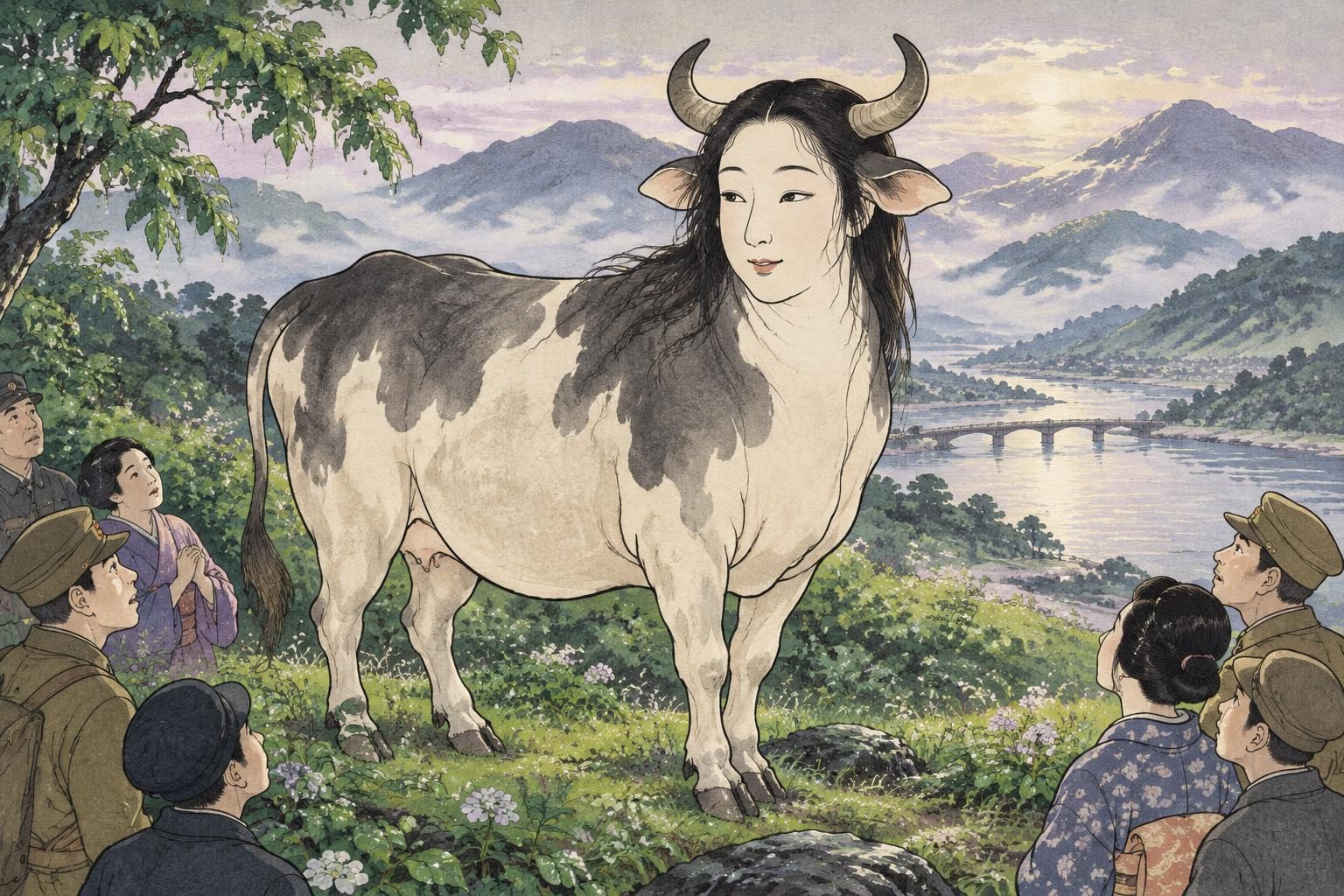
In Iwakuni, Yamaguchi Prefecture, a mysterious yokai known as the Kudan is said to have appeared during World War II, prophesying the war’s end. This mythical creature, with the face of a human and the body of a cow, has captured the imagination of many, blending folklore with historical events.


What Is a Kudan? The Prophetic Beast of Japanese Folklore
FACT: The Yokai’s Characteristics
The Kudan is a unique yokai in Japanese folklore, known for its distinctive appearance and prophetic abilities. Typically depicted with the face of a human and the body of a cow, the Kudan is believed to possess the power to predict significant events. These predictions are often dire, and the creature is said to die shortly after delivering its prophecy. The Kudan’s origins are rooted in Edo-period broadsheets, where it was first documented as a creature of ominous predictions. These early depictions contributed to the yokai’s mysterious aura, making it a subject of intrigue and fear.
LEGEND: The Story of the Iwakuni Kudan
According to local legend, in 1943, a Kudan appeared in Iwakuni, Yamaguchi Prefecture. This yokai reportedly predicted the end of World War II in April or May, a prophecy that resonated with the local population amidst the turmoil of war. The legend suggests that the Kudan’s appearance was a sign of hope during a time of uncertainty and fear. While the exact location of this event is tied to a geta shop in Iwakuni, the details remain elusive, adding to the mystique of the tale. The geta shop, though unspecified in location, serves as a symbolic place where the supernatural and the mundane intersect.

The 1943 Iwakuni Legend: A Wartime Prophecy
FACT: Documented Rumors and Military Records
During World War II, rumors of the Kudan’s prophecy spread through Iwakuni, capturing the attention of both locals and authorities. Military police records from the time, as noted by sources such as note.com, document these rumors, indicating the level of belief and concern they generated. These records provide a glimpse into how folklore can influence and reflect societal anxieties during wartime. The presence of such records underscores the impact of the Kudan legend on the community, illustrating how deeply folklore can permeate daily life and official domains.
LEGEND: Variants of the Prophecy
Different accounts of the Kudan’s prophecy exist, with some variations in the details of the prediction. While the core message remained the same—the war would end in April or May—the manner in which the Kudan delivered this prophecy is subject to local interpretation. Some versions suggest the Kudan spoke directly to a shopkeeper, while others imply it was a more ethereal communication. These variants highlight the fluid nature of oral traditions and the role of community storytelling in preserving cultural narratives. The diversity in these stories reflects the adaptability of folklore, allowing it to resonate with different audiences and contexts.


Regional Anxieties: Kudan Legends Across Chugoku
FACT: The Spread of Kudan Stories
The Kudan legend is not unique to Iwakuni; similar stories have been reported across the Chugoku region. These tales often emerge during times of crisis, serving as a cultural mechanism for communities to process fear and uncertainty. The spread of Kudan stories during wartime reflects a broader pattern of using folklore to make sense of the unknown and to provide a semblance of control over unpredictable events. The recurrence of such legends across different locales suggests a shared cultural response to collective anxieties, where the Kudan becomes a vessel for expressing and managing communal fears.
LEGEND: The Kudan’s Role in Local Folklore
In Yamaguchi and beyond, the Kudan has become a symbol of prophecy and mystery. Local traditions often depict the Kudan as a harbinger of change, its appearance signaling a turning point in the community’s fate. These stories are passed down through generations, each retelling adding layers of meaning and interpretation. The Kudan’s enduring presence in local folklore underscores its significance as a cultural touchstone. Its role as a prophetic figure highlights the human desire to find meaning in chaos and to seek guidance from the supernatural during challenging times.
From Edo Broadsheets to Wartime Omens: The Evolution of Kudan Beliefs
FACT: Historical Documentation
Historical documentation of the Kudan dates back to the Edo period, where it was featured in broadsheets as a creature of ominous predictions. These early accounts laid the foundation for the Kudan’s role in Japanese folklore, establishing its reputation as a prophetic being. The transition from historical documentation to wartime legend illustrates the adaptability of folklore in addressing contemporary issues. This evolution demonstrates how traditional stories can be repurposed to meet the needs of different eras, maintaining their relevance and appeal across generations.
LEGEND: Modern Interpretations
Today, the Kudan continues to be a subject of fascination and reinterpretation. Modern storytellers and folklorists explore the Kudan’s role in historical and contemporary contexts, examining how its legend has evolved over time. This ongoing interest in the Kudan reflects a broader appreciation for yokai culture and its ability to connect past and present narratives. The Kudan’s story serves as a reminder of the enduring power of folklore to captivate the imagination and to provide insight into the cultural psyche.


Exploring Iwakuni and Yamaguchi’s Rich Historical Lore
FACT: Iwakuni’s Cultural Heritage
Iwakuni is rich in cultural heritage, with landmarks such as the Kintaikyo Bridge and Iwakuni Castle offering glimpses into the region’s past. These sites, along with the enduring legend of the Kudan, contribute to Iwakuni’s identity as a place where history and folklore intertwine. Visitors to Iwakuni can explore these connections, experiencing firsthand the blend of myth and history that defines the area. The presence of these historical sites provides a tangible context for the intangible stories, allowing visitors to immerse themselves in the cultural landscape of Iwakuni.
Nearby Guide
Access
- Iwakuni Station (Iwakuni) — From JR Iwakuni Station, take a bus to Kintaikyo Bridge (about 20 minutes). Alternatively, the bridge is approximately a 20-minute walk from Kawanishi Station. official site
Nearby sights
- Kintaikyo Bridge (Iwakuni) — The Kintaikyo Bridge is a 17th-century wooden bridge spanning the Nishiki River, renowned for its five arches and historical significance. It’s a must-see landmark in Iwakuni. official site
- Iwakuni Castle (Iwakuni) — Perched atop Mount Shiroyama, Iwakuni Castle offers panoramic views of the city and the Kintaikyo Bridge. A ropeway ride from Kikko Park takes visitors up to the castle. details
- Kikko Park & the Samurai Quarter (Iwakuni) — Kikko Park, once the residence of the Kikkawa lords, features moats, fountains, shrines, and preserved samurai houses like the Mekata residence. It’s a serene spot to explore Iwakuni’s feudal history. details
Where to stay
- Hotel Iwakuni (Iwakuni) — Hotel Iwakuni offers comfortable accommodations with easy access to the Kintaikyo Bridge and other local attractions. It’s a convenient choice for travelers. official site
Where to eat
- Bote Q (Iwakuni) — Bote Q is a cozy eatery specializing in Hiroshima-style okonomiyaki, a savory pancake dish. Located near Iwakuni Station, it’s a popular spot for both locals and visitors. details


Related on JAPAN ESSENCE: Osan-Gitsune: The Legend of Iwakuni’s Shapeshifting Fox Spirit | Konaki-Jijii: The Legend of Tokushima’s Crying Old Man Yokai
Sources
- Memories of the Sunken Taira Clan | YOKAI.JP
- Chugoku Region – Yokai & Folklore of Japan | Kami Crew – Folklore
- wikipedia.org
- note.com
- official site
- details
- details
To explore further, visit Kawara Kobo (瓦工房) for a hands-on kawara experience and Zenkei (禅景) for Zen-inspired onigawara art.
山口県岩国市では、第二次世界大戦中にクダンと呼ばれる神秘的な妖怪が現れ、戦争の終結を予言したと言われています。この人間の顔と牛の体を持つ神話的な生き物は、多くの人々の想像力をかき立て、民間伝承と歴史的な出来事を融合させています。
クダンとは?日本の民間伝承の予言獣
事実: 妖怪の特徴
クダンは、日本の民間伝承において独特な妖怪で、その特異な外見と予言能力で知られています。通常、人間の顔と牛の体を持つと描かれ、重要な出来事を予言する力を持つと信じられています。これらの予言はしばしば不吉であり、予言を伝えた後にクダンはすぐに死ぬと言われています。クダンの起源は江戸時代の瓦版に根ざしており、そこで初めて不吉な予言をする生き物として記録されました。これらの初期の描写は、妖怪の神秘的なオーラに寄与し、興味と恐怖の対象となっています。
伝承: 岩国クダンの物語
地元の言い伝えによると、1943年に山口県岩国市でクダンが現れたと言われています。この妖怪は、4月か5月に第二次世界大戦が終わると予言したとされています。この予言は、戦争の混乱の中で地元の人々に希望の兆しとして響きました。伝説によれば、クダンの出現は不確実性と恐怖の時代における希望の象徴でした。この出来事の正確な場所は岩国の下駄屋に結びつけられていますが、詳細は不明であり、物語の神秘性を高めています。この下駄屋は、場所は特定されていませんが、超自然と日常が交差する象徴的な場所として機能しています。
1943年の岩国伝説: 戦時中の予言
事実: 記録された噂と軍事記録
第二次世界大戦中、クダンの予言の噂が岩国中に広まり、地元の人々や当局の注目を集めました。note.comなどの情報源によると、当時の憲兵隊の記録にはこれらの噂が記録されており、それが引き起こした信念と懸念のレベルを示しています。これらの記録は、戦時中の社会的不安を反映し、民間伝承がどのように影響を与え、反映するかを垣間見ることができます。このような記録の存在は、クダン伝説がコミュニティに与えた影響を強調し、民間伝承が日常生活や公式の領域にどれほど深く浸透するかを示しています。
伝承: 予言のバリエーション
クダンの予言には異なる説があり、予言の詳細にはいくつかのバリエーションがあります。核心となるメッセージは同じであり、戦争は4月か5月に終わるというものでしたが、クダンがこの予言をどのように伝えたかは地元の解釈に委ねられています。あるバージョンでは、クダンが直接店主に話しかけたとされ、他のバージョンでは、より霊的なコミュニケーションであったとされています。これらのバリエーションは、口承の伝統の流動性と、文化的な物語を保存するコミュニティの役割を強調しています。これらの物語の多様性は、民間伝承の適応性を反映しており、異なる聴衆や文脈に共鳴することを可能にしています。
地域の不安: 中国地方に広がるクダン伝説
事実: クダン物語の広がり
クダン伝説は岩国に限らず、中国地方全体で類似の物語が報告されています。これらの物語は、危機の時期にしばしば現れ、コミュニティが恐怖や不安を処理するための文化的メカニズムとして機能します。戦時中にクダン物語が広がったことは、未知のものを理解し、予測不可能な出来事に対する制御感を提供するために民間伝承を使用する広範なパターンを反映しています。異なる地域でこのような伝説が繰り返されることは、集団的不安に対する共有された文化的反応を示唆しており、クダンが共同体の恐怖を表現し管理するための器となっていることを示しています。
伝承: 地元の民間伝承におけるクダンの役割
山口県やその周辺では、クダンは予言と神秘の象徴となっています。地元の伝統では、クダンは変化の前触れとして描かれることが多く、その出現はコミュニティの運命の転換点を示しています。これらの物語は世代を超えて受け継がれ、それぞれの語りが意味と解釈の層を追加しています。クダンが地元の民間伝承において持続的な存在であることは、文化的な基準点としてのその重要性を強調しています。予言的な存在としてのその役割は、混沌の中で意味を見つけ、困難な時期に超自然的なものから指針を求める人間の欲求を浮き彫りにしています。
江戸の瓦版から戦時中の前兆へ: クダン信仰の進化
事実: 歴史的な文書
クダンの歴史的な文書は江戸時代に遡り、不吉な予言をする生き物として瓦版に登場しました。これらの初期の記録は、日本の民間伝承におけるクダンの役割の基礎を築き、予言的な存在としての評判を確立しました。歴史的な文書から戦時中の伝説への移行は、現代の問題に対処するために民間伝承がどのように適応するかを示しています。この進化は、伝統的な物語が異なる時代のニーズに応じて再利用され、その関連性と魅力を世代を超えて維持する方法を示しています。
伝承: 現代の解釈
今日、クダンは引き続き魅力と再解釈の対象となっています。現代の語り手や民俗学者は、クダンの歴史的および現代的な文脈における役割を探求し、その伝説が時を経てどのように進化してきたかを検証しています。クダンへのこの継続的な関心は、妖怪文化とその過去と現在の物語を結びつける能力に対する広範な評価を反映しています。クダンの物語は、民間伝承の持続的な力を想像力をかき立て、文化的な心理に洞察を与えるものとして思い出させます。
岩国と山口の豊かな歴史的伝承を探る
事実: 岩国の文化遺産
岩国は文化遺産が豊富で、錦帯橋や岩国城などのランドマークが地域の過去を垣間見ることができます。これらの場所は、クダンの持続的な伝説とともに、歴史と民間伝承が交差する場所としての岩国のアイデンティティに貢献しています。岩国を訪れる人々は、これらのつながりを探求し、地域を定義する神話と歴史の融合を直接体験することができます。これらの歴史的な場所の存在は、無形の物語に対する具体的な文脈を提供し、訪問者が岩国の文化的な風景に没入することを可能にします。
周辺ガイド
アクセス
- 岩国駅(岩国)— JR岩国駅から錦帯橋まではバスで約20分です。徒歩の場合は、川西駅から約20分です。公式サイト
周辺の見どころ
- 錦帯橋(岩国)— 錦帯橋は17世紀の木製の橋で、錦川を渡る5つのアーチと歴史的な重要性で知られています。岩国で必見のランドマークです。公式サイト
- 岩国城(岩国)— 城山の頂上に位置する岩国城は、市内と錦帯橋のパノラマビューを提供します。吉香公園からロープウェイで城まで行くことができます。詳細
- 吉香公園と侍の町(岩国)— 吉香公園は、かつて吉川氏の居住地であり、堀、噴水、神社、保存された侍の家屋(目加田家住宅など)があります。岩国の封建時代の歴史を探るのに最適な静かなスポットです。詳細
泊まる
- ホテル岩国(岩国)— ホテル岩国は、錦帯橋や他の地元の観光スポットへのアクセスが容易な快適な宿泊施設を提供しています。旅行者にとって便利な選択肢です。公式サイト
食べる
- ぼてQ(岩国)— ぼてQは、広島風お好み焼きという風味豊かなパンケーキ料理を専門とする居心地の良い食堂です。岩国駅の近くにあり、地元の人々や訪問者に人気のスポットです。詳細
Related on JAPAN ESSENCE: Osan-Gitsune: The Legend of Iwakuni’s Shapeshifting Fox Spirit | Konaki-Jijii: The Legend of Tokushima’s Crying Old Man Yokai
Leave a Reply